
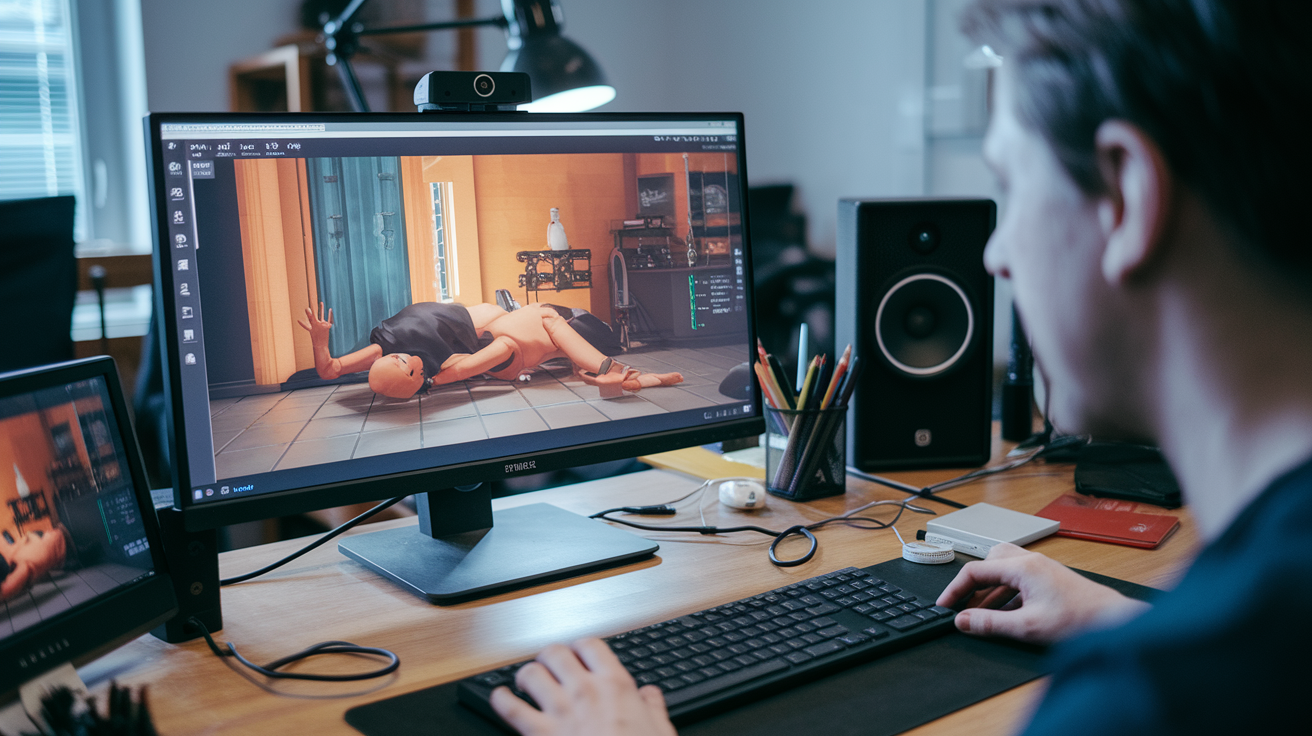
What if the lifelike motion you notice in modern games isn’t hand animated, but decided by code and physics in real time?
Procedural animation uses algorithms, like inverse kinematics, ragdoll physics, and noise, to calculate joint positions, foot placement, cloth motion, and small breathing so characters respond to uneven ground, collisions, and player input instead of replaying canned clips.
That real-time approach creates more believable characters, cuts the need for endless keyframes, and makes moments like a stumble on stairs or a cape billowing in wind feel natural and unpredictable in a good way.
Core Explanation of Procedural Animation and Its Realism Impact
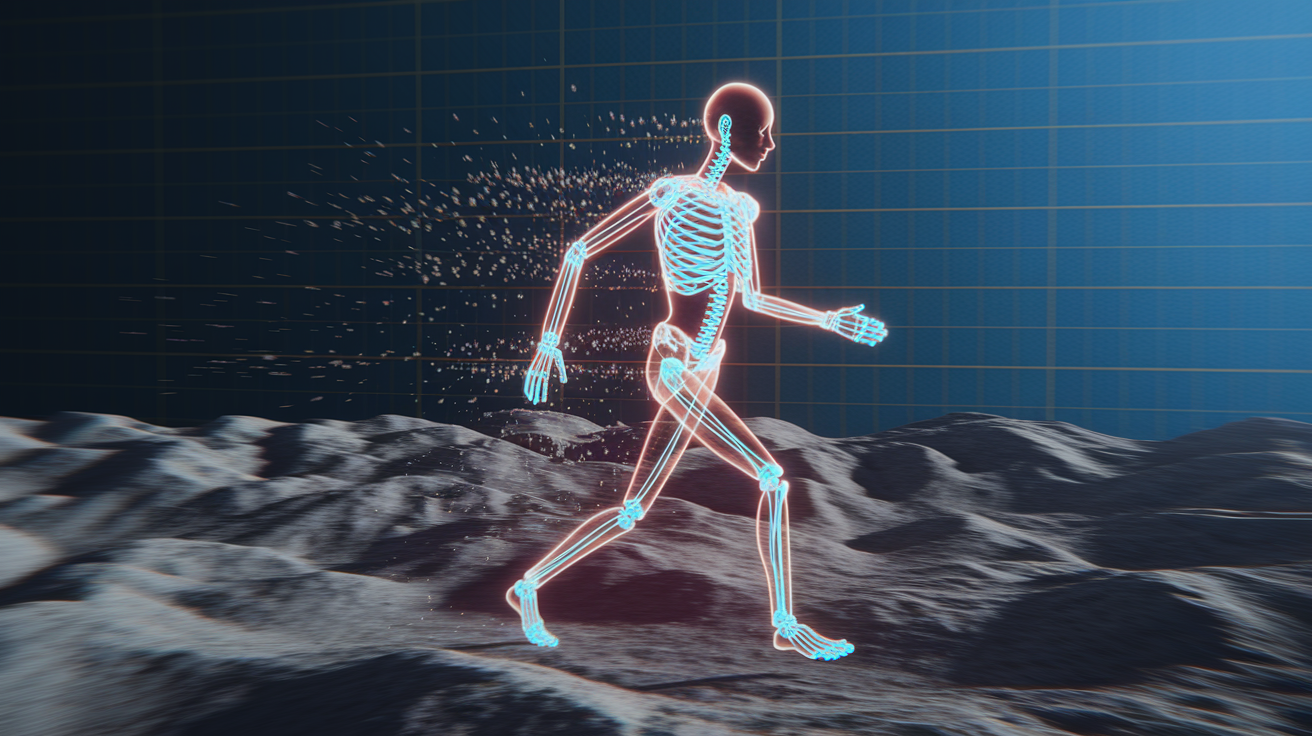
Procedural animation is motion that gets created through algorithms instead of someone drawing it frame by frame. Rather than an animator manually placing a character’s hand in the exact right spot at the exact right time, code figures out where joints should go, how bodies react, and what happens when stuff collides. All in real time. This lets characters respond to weird terrain, unexpected player moves, and physics interactions without needing thousands of pre-made clips sitting in memory. When you see a character walking across bumpy ground in a modern game and each footstep actually lands where it should? That’s procedural systems adjusting angles on the fly instead of just looping the same flat-ground walk cycle.
Traditional keyframe animation means you’re creating every possible scenario by hand. Walk cycles for every surface. Jump variations. Different falls. It’s repetitive, and you can’t predict everything players will do anyway. Procedural systems replace that grind with adaptive algorithms that calculate motion as it happens. The result feels more convincing because characters actually respond to physics, gravity, and what you’re doing with the controller rather than picking from a menu of canned moves. When a ragdoll tumbles down stairs, the solver is calculating how each limb hits each step edge in that exact moment. It’s unpredictable but it looks right.
Real applications of this show up everywhere. Ragdoll physics simulate body collapses using rigid constraints. Inverse kinematics adjusts where feet land so characters don’t hover above stairs or clip through rubble. Particle systems generate water ripples and smoke that react to wind and movement. Cloth and hair follow physics rules, giving you flowing capes and ponytails that actually respond to how fast someone’s running.
The main procedural systems used to make things look real:
- Physics-based animation that simulates gravity, collisions, and how materials behave
- Inverse kinematics solvers that calculate joint rotations so limbs end up where they need to be
- Particle systems for fire, smoke, water splashes, debris
- Behavioral animation using AI rules to drive NPC reactions
- Secondary motion simulation for cloth, hair, accessories responding to primary movement
Algorithmic Foundations Behind Procedural Animation Systems
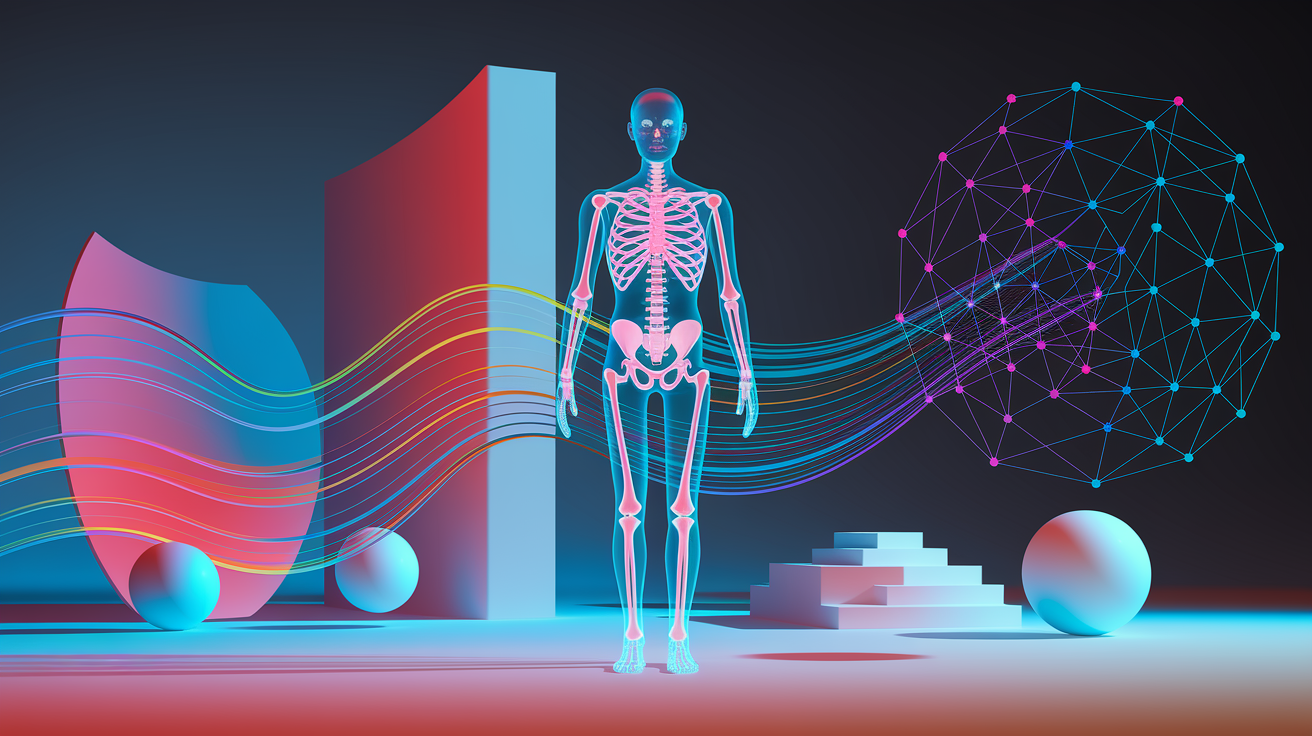
Noise functions are the math underneath a lot of procedural motion. Perlin noise and simplex noise add controlled randomness to animation, creating subtle stuff like hand tremors, breathing, idle shifts that keep characters from looking frozen. These functions take position and time as inputs and spit out smoothly varying numbers that get mapped to rotation tweaks, position jitter, blend weights. Layer multiple frequencies together and you get complex micro-movements. A character shifting weight while standing. Leaves rustling.
Inverse kinematics is a solver that figures out what joint rotations you need to put an endpoint somewhere specific. You want a hand to grab that doorknob? The IK algorithm works backward through the arm chain to determine how much each joint rotates to reach that spot while respecting real constraints like how far an elbow can actually bend. Two-bone systems handle simple chains like arms and legs with geometric solutions. More complex setups use iterative methods for longer chains, spines, tentacles. This lets characters reach for things, plant feet on weird surfaces, aim weapons without needing hand-animated frames for every possible configuration.
Constraint solvers enforce rules about how joints and bodies can move relative to each other. They prevent limbs from bending the wrong way, keep feet planted during weight shifts, maintain balance. Physics-based constraints use spring forces and damping to connect rigid bodies at joints, which produces natural secondary motion as forces ripple through the skeleton. Position-based dynamics solve constraints iteratively each frame, adjusting bones to satisfy multiple overlapping rules at once.
Blending and rule systems coordinate all these procedural algorithms into something coherent. State machines determine which layers are active based on what’s happening in the game. Switching between locomotion modes, combat stances, interaction poses. Layered blending combines results from different systems. Maybe you’re overlaying IK foot adjustments onto a base walk cycle while adding noise-driven breathing. Rule-based decision trees select responses like flinching from explosions or turning to track movement, all calculated without pre-made animation.
Realism Gains from Procedural Motion in Modern Games
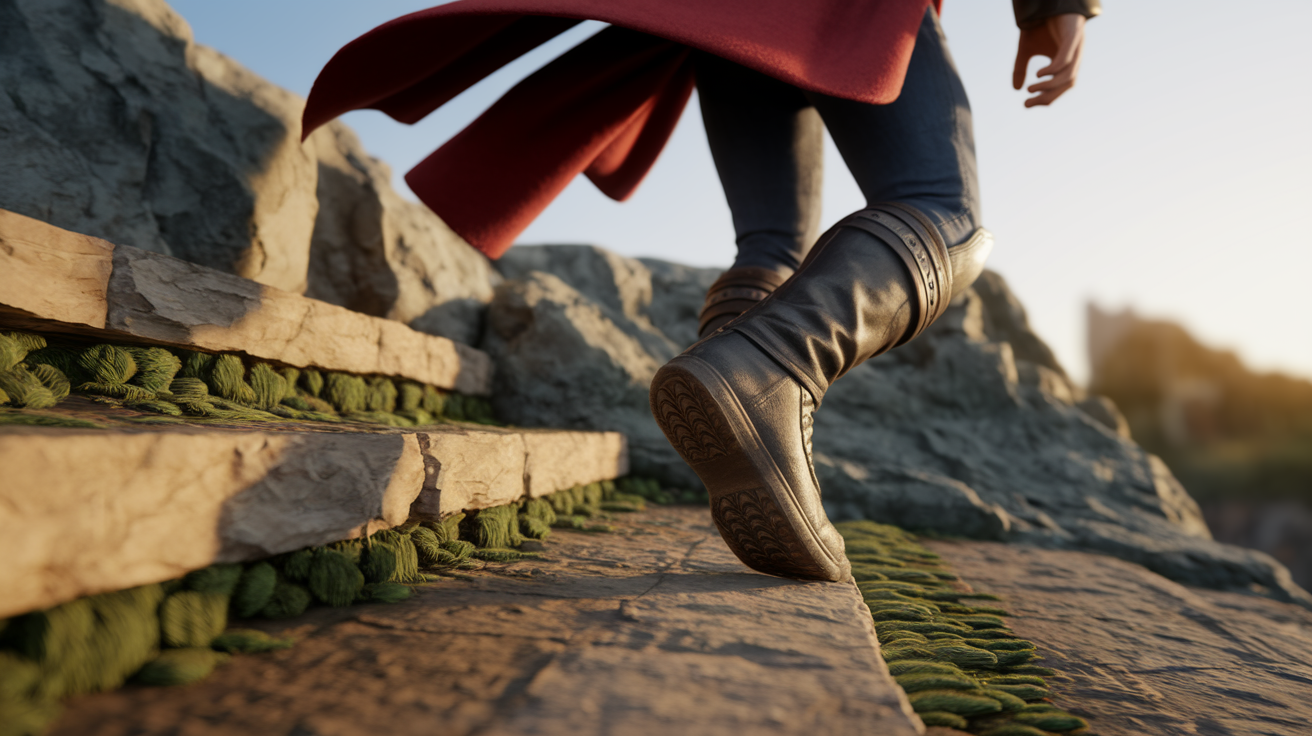
Adaptive movement makes characters respond to their environment instead of ignoring it. Procedural foot placement adjusts stride length, ankle rotation, leg extension so someone walking up stairs doesn’t float above them or sink through. Weight distribution shifts when you’re carrying something or leaning around a corner, preventing that stiff upright posture that kills immersion. Environmental reactivity extends to smaller details. Characters brace against wind, shield their eyes in dust, adjust their walk on ice. All calculated based on simulation data.
Procedural crowd behavior creates believable population density without animating every background person individually. Simple rules like maintaining personal space, matching nearby walking speeds, avoiding collisions produce realistic pedestrian flow through streets. NPCs react to you with procedural head turns, step-asides, postural adjustments that make worlds feel inhabited. These systems scale because the same algorithm drives hundreds of agents at once, each calculating its own path based on local conditions.
Red Dead Redemption 2’s horse mechanics demonstrate terrain-adaptive motion. The mount’s gait, posture, footfalls change based on ground slope, surface type, speed. Riding through mud feels different than galloping over dirt because the procedural system adjusts blend weights and IK targets in real time. Spore generates creature animations that match whatever weird thing you designed, with locomotion and behaviors emerging from skeletal structure and AI rules instead of pre-made libraries.
Four techniques driving these improvements:
- Terrain adaptation systems measuring ground height and slope to adjust foot placement, body lean, stride parameters
- Emergent NPC logic using behavior trees to select contextual reactions from procedural motion libraries
- Crowd motion algorithms applying flocking rules and avoidance to generate group movement
- Responsive character reactions calculating procedural flinches, glances, postural shifts based on nearby events
Comparing Procedural Animation and Traditional Keyframing
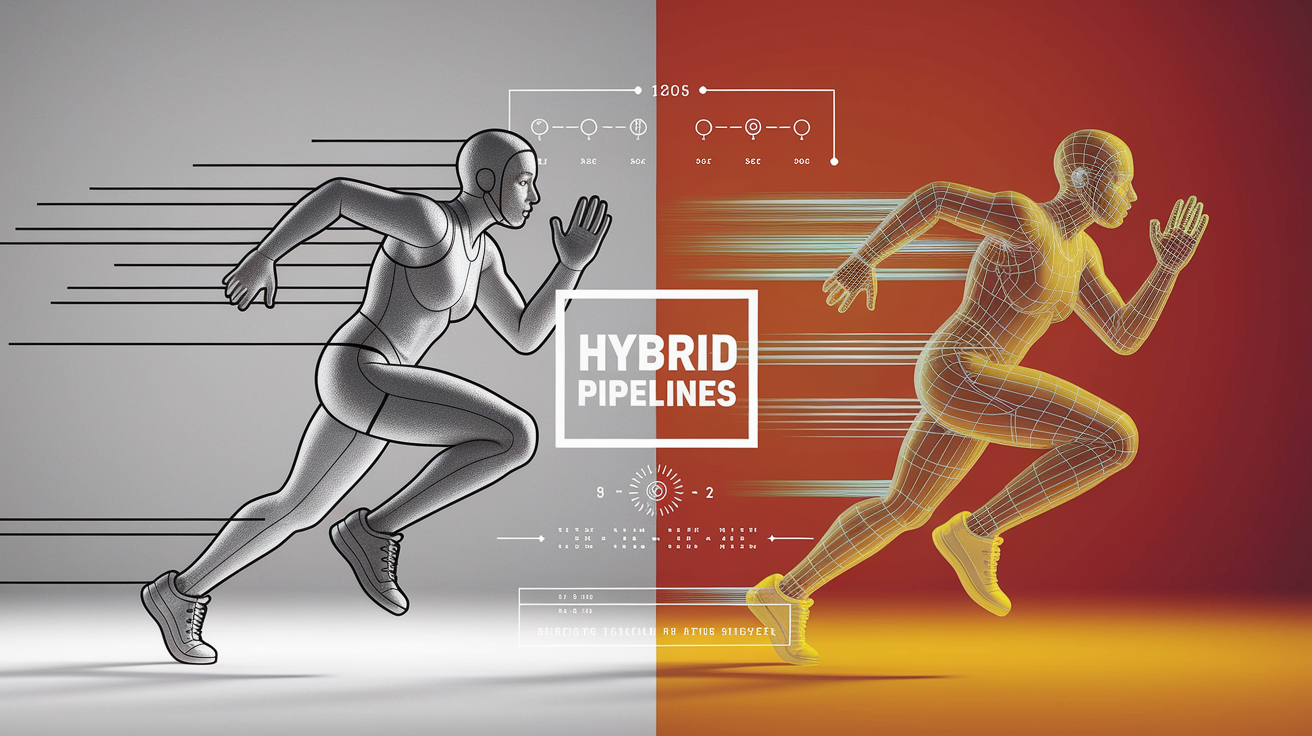
Traditional keyframe animation gives you precise control over timing, posing, performance. It’s perfect for cinematic moments, hero actions, anything requiring specific emotional beats. Animators sculpt each frame to convey intention, weight, personality. The result matches directorial vision exactly. This handcrafted approach excels at character acting, facial expressions, stylized movement where artistic intent matters more than physical accuracy. The limitation is scalability. Creating unique animations for every possible scenario gets impractical fast as world complexity grows.
Procedural motion reduces repetitive work by generating variations algorithmically. Developers create responsive systems that adapt to unpredictable actions and environmental conditions. Instead of authoring separate walk cycles for gravel, sand, mud, snow, a single procedural locomotion system adjusts based on surface properties. This becomes critical in open-world games with diverse terrain and emergent gameplay. The trade-off is less precise artistic control. Procedural systems can produce unexpected results that need tuning, and purely algorithmic motion sometimes lacks the personality of hand-keyed performance.
Hybrid pipelines combine both approaches. Keyframed animation for important narrative moments and core movement cycles. Procedural layers for adaptation and variation. A character’s base run cycle might be hand-animated to establish personality, then enhanced with procedural IK for foot placement on slopes, procedural noise for breathing, physics-based cloth simulation for costume details. Ragdoll systems often activate only during specific events, blending smoothly from directed keyframe motion into physics-driven collapse.
| Approach | Strength | Weakness |
|---|---|---|
| Keyframe | Precise artistic control, emotional performance, stylized timing | High manual workload, limited scalability, no runtime adaptation |
| Procedural | Adaptive to environment, efficient variation, responsive to player input | Less artistic precision, requires tuning, can produce unexpected results |
| Hybrid | Combines authored performance with adaptive realism, balances control and efficiency | Requires coordination between animators and engineers, more complex pipeline |
Inverse Kinematics and Procedural Locomotion for Realistic Movement
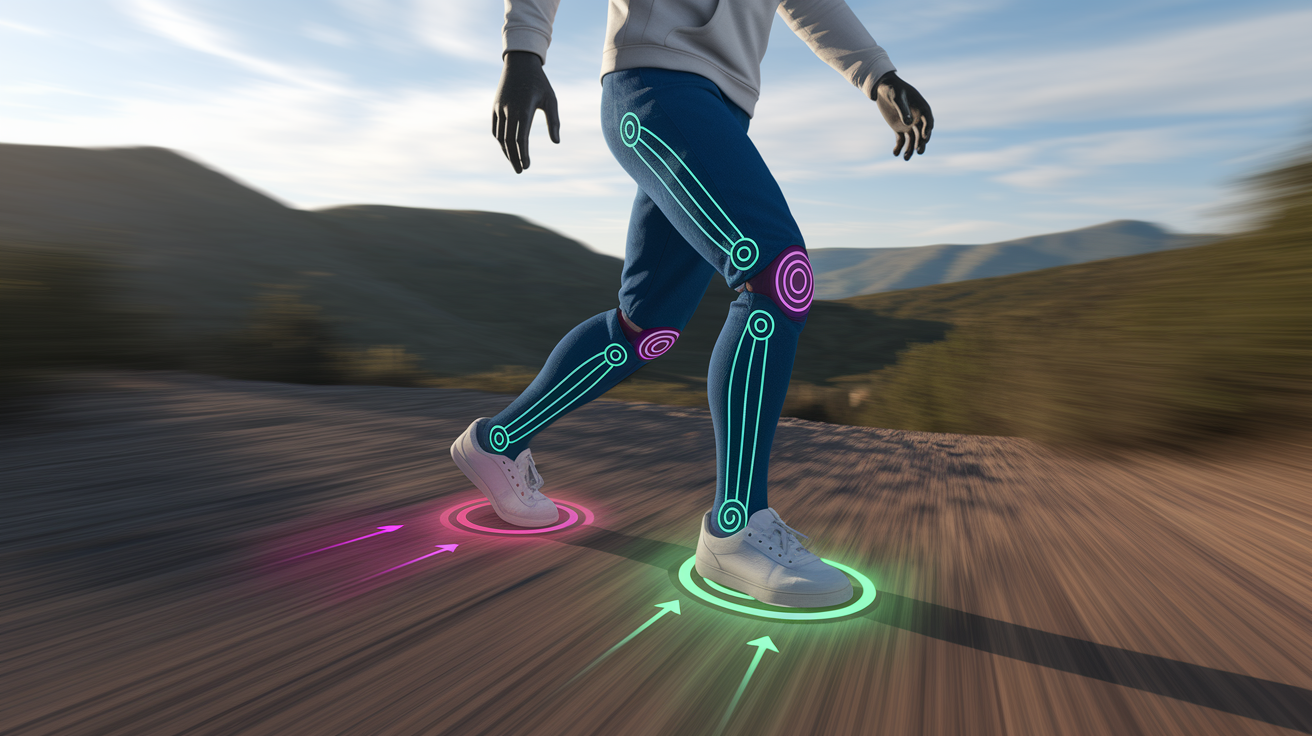
Inverse kinematics calculates joint rotations needed to position a limb’s endpoint at a target. When a character needs to plant a foot on an uneven rock, the IK solver figures out how much to bend the ankle, knee, hip so the foot contacts the surface while keeping balance. Two-bone IK handles simple chains like arms and legs using geometric solutions that run efficiently every frame. Complex skeletons require iterative solvers that progressively adjust angles until the endpoint reaches the target within acceptable tolerance. This produces natural limb configurations that respect anatomical constraints like rotation limits and preferred bend directions.
Procedural locomotion systems use IK as a core component to generate adaptive walking, running, climbing that responds to terrain geometry. These systems cast rays downward from predicted foot positions to detect ground height and slope, then use that data to set IK targets that plant feet correctly on stairs, hills, irregular surfaces. Stride length adjusts based on speed and obstacle proximity. Leg extension adapts to step height differences. Ankle rotation aligns feet with surface normals to prevent floating or clipping. The result is characters that navigate complex environments with believable weight distribution and ground contact.
Terrain-Adaptive Motion
Foot placement algorithms continuously sample the environment to find valid contact points for each step, adjusting IK targets frame by frame as terrain changes. These systems measure surface normals to calculate ankle rotation, detect step height differences to extend or compress legs, apply small corrective offsets to smooth transitions. Surface detection typically uses raycasts fired downward from predicted foot positions, with the impact point and normal fed into IK solvers as the new target. Leg-length adjustment prevents characters from looking like they’re on tiptoes when descending slopes or squatting unnaturally when climbing.
Mitigation of foot sliding requires locking planted feet in world space during the support phase of each step, overriding procedural motion to maintain ground contact until the foot lifts for the next stride. This “foot lock” technique compares the foot’s IK target position to its previous frame location and clamps movement to zero when the foot should stay planted. Release conditions check for sufficient weight transfer and appropriate timing in the gait cycle before unlocking. These systems work alongside root motion and velocity matching to keep characters grounded convincingly.
Procedural Secondary Motion and Environmental Effects
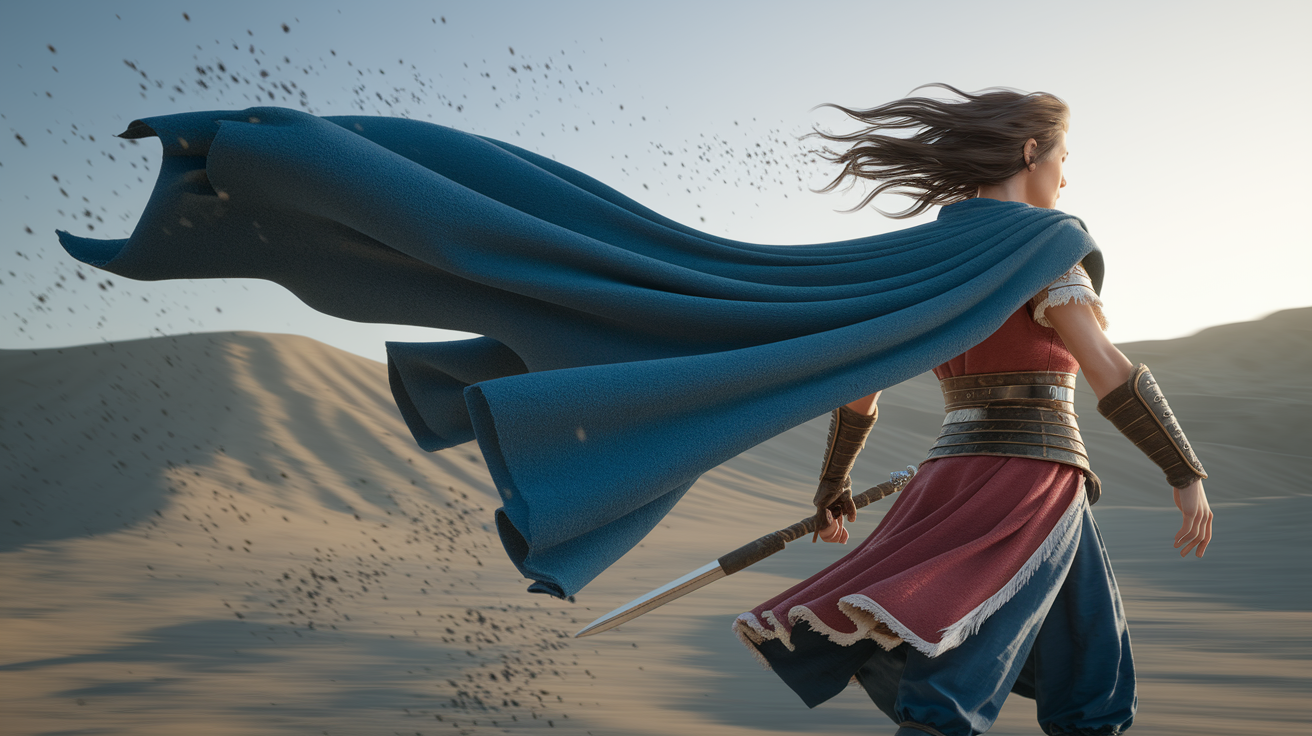
Procedural secondary motion adds realism through automatic simulation of details that respond to primary character movement and environmental forces. Physics-based cloth systems calculate fabric behavior based on vertex masses, spring constraints, collision detection. Realistic wrinkles, sways, billowing as characters move and wind applies forces. Hair simulation uses similar principles with strand dynamics. Ponytails swing naturally, beards sway during head turns, loose hair responds to running speed. These systems read skeleton motion as input and generate believable follow-through that would be tedious to animate by hand for every movement variation.
Particle systems generate fluid and environmental effects through simulation of large numbers of elements following physics rules:
- Cloth simulations compute vertex positions based on spring constraints, gravity, collision detection against character geometry and environment objects
- Hair dynamics calculate strand motion using simplified physics chains, each segment inheriting velocity from its parent and adding drag, stiffness, collision response
- Fluid particle effects spawn water droplets, smoke, fire embers that follow ballistic trajectories, respond to wind, fade over time based on lifespan rules
- Soft-body reactions deform mesh geometry when characters press against surfaces, calculating vertex displacement based on penetration depth and material stiffness
- Collision-driven secondary motion propagates impact forces through skeletal chains and attached accessories, making weapons sway when characters change direction
Behavior-Driven Procedural Animation for NPC Realism
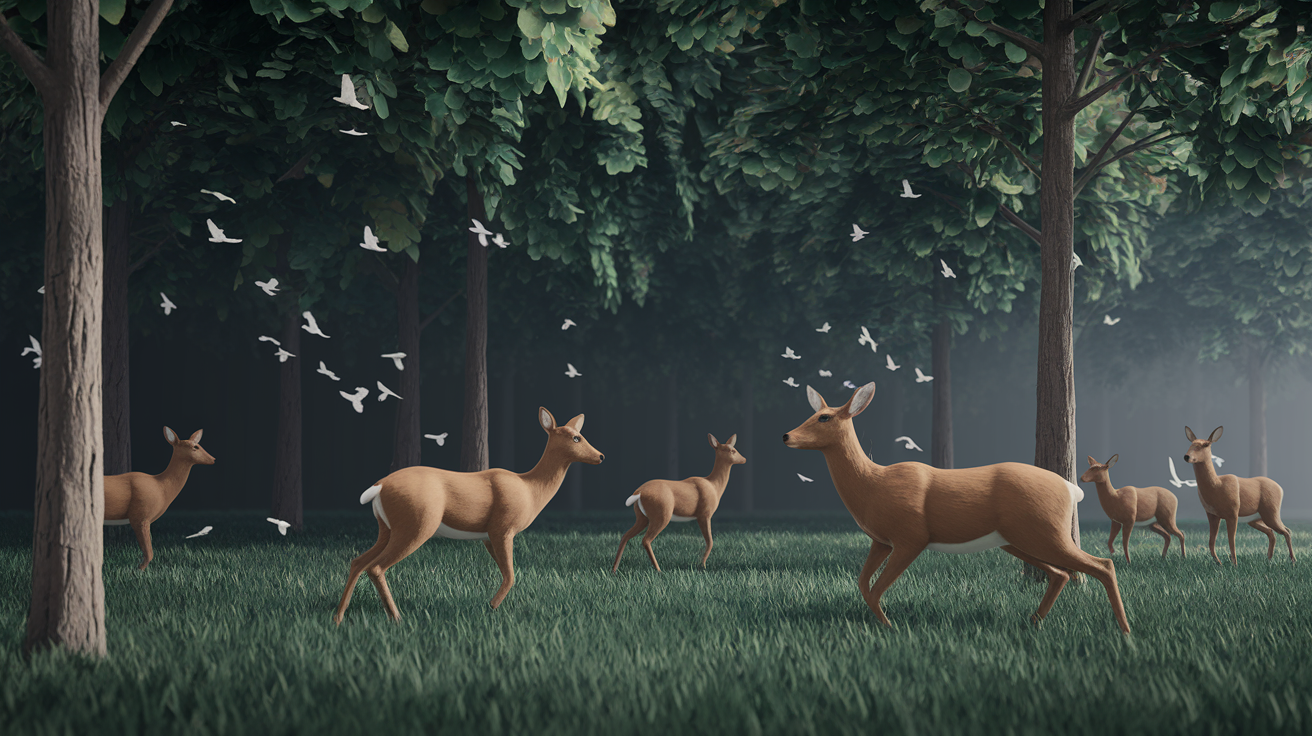
Behavioral animation uses AI decision systems to drive procedural motion, selecting and blending animations based on context, environmental stimuli, NPC goals rather than playing pre-scripted sequences. Rule-based systems evaluate game state each frame to determine appropriate reactions. An NPC might procedurally turn toward sudden noises, raise hands defensively when threatened, lean in to examine interesting objects based on proximity and attention rules. These decisions feed into procedural animation layers that calculate head orientation, eye direction, postural adjustments, gesture timing. Responsive characters that appear aware of their surroundings.
Species-specific and group-based emergent behavior adds authenticity by encoding natural response patterns. A deer might freeze and crouch when detecting the player, using procedural posture adjustment and head-turn animation to track the threat before triggering a flee behavior with procedural path-following and obstacle avoidance. A bear uses different rules, standing upright to assess danger and generating procedural charge motion if you approach too close. Group behaviors emerge from individual agents following simple rules like maintaining formation spacing, matching nearby movement speeds, coordinating alerts. Realistic herd and pack dynamics without centralized scripting.
Spore demonstrates adaptive procedural reactions by generating creature behavior from skeletal structure and part configuration. Locomotion gaits, feeding animations, social interactions emerge from the procedural system rather than pre-authored libraries. A creature with long legs and heavy body automatically generates a lumbering walk cycle, while a small nimble design produces quick darting movements. All calculated by the same underlying framework analyzing limb proportions and mass distribution. Predator encounters trigger species-appropriate defensive behaviors selected by AI rules and executed through procedural animation matching each creature’s unique anatomy.
Performance Considerations for Real-Time Procedural Animation
Real-time procedural animation demands significant computational resources because motion calculations happen every frame for every active character and simulation. Physics-based systems solve collision detection, constraint satisfaction, force integration for rigid bodies and soft materials. Operations that scale with character complexity and interaction density. Inverse kinematics runs iterative solvers that may require multiple passes per limb to converge on stable solutions, especially for long skeletal chains or complex multi-target scenarios. These costs multiply across dozens or hundreds of characters in crowded scenes, quickly consuming CPU and GPU budgets unless you apply careful optimization.
Hardware requirements directly impact procedural animation quality and scope. RAM capacity determines how many simulation states and skeletal hierarchies can remain active simultaneously. Graphics card power affects particle counts, cloth resolution, parallel physics calculations. Modern procedural systems benefit from plenty of RAM and a powerful graphics card because they maintain per-frame state for numerous simulation elements. Particle positions and velocities, cloth vertex histories, IK solver intermediate results, behavioral animation decision trees. Balancing quality against frame rate requires profiling tools to identify bottlenecks and strategic decisions about which characters get full procedural treatment versus simplified approximations based on screen importance and distance from camera.
Optimization strategies for maintaining performance:
- Reducing procedural complexity by lowering iteration counts for IK solvers and simplifying physics constraints for distant or occluded characters
- Animation level-of-detail systems that switch characters between full procedural simulation, simplified approximations, static poses based on camera distance and visibility
- GPU offload of parallel calculations like particle updates, cloth vertex simulation, crowd behavior evaluation using compute shaders
- Iterative tuning of simulation parameters to find acceptable quality thresholds that preserve believability while staying within performance budgets
Practical Workflow Tips for Using Procedural Animation in Production

Production pipelines for procedural animation typically combine visual node-based editors with code modules. Technical artists build and tune procedural systems without writing low-level code while engineers optimize critical paths. Tools like Unity’s Animation Rigging package, Unreal’s Control Rig, Houdini’s procedural networks provide graph interfaces for connecting IK solvers, constraint systems, behavioral logic into reusable animation rigs. These workflows let teams iterate quickly on procedural parameters, adjusting IK target offsets, physics material properties, behavioral thresholds while previewing results in real time on representative game scenarios.
Collaboration between animators and programmers determines procedural animation success. Artists understand movement quality and intentionality. Engineers manage algorithmic implementation and performance optimization. Regular reviews where animators demonstrate desired motion and engineers explain technical constraints help teams find hybrid solutions that balance artistic vision with runtime feasibility. Iterative testing across diverse gameplay scenarios reveals edge cases where procedural systems produce unintended results. Hand sliding during wall-touches, feet penetrating stairs, behavioral loops in narrow spaces. Teams address these through parameter refinement and constraint adjustments.
Blending handcrafted and algorithmic motion lets teams apply each approach where it provides maximum value. Keyframed animation for signature moves and critical narrative moments. Procedural systems for environmental adaptation and variation generation. A character’s combat attacks might use carefully authored keyframes to convey power and timing, enhanced with procedural IK to adjust foot placement on slopes and procedural recoil when striking different material types. This layered approach maintains artistic control over primary motion while gaining realism benefits from procedural adaptation to context.
Three practical workflow steps for production integration:
- Prototype procedural systems on representative characters and scenarios early to validate performance budgets and identify technical risks before full production commitment
- Build debugging visualizations that display IK targets, constraint forces, behavioral state transitions so artists and engineers can diagnose unexpected motion quickly
- Establish clear parameter ownership and version control for procedural rig configurations so multiple team members can iterate without overwriting tuning work
Case Studies Demonstrating Procedural Animation Realism
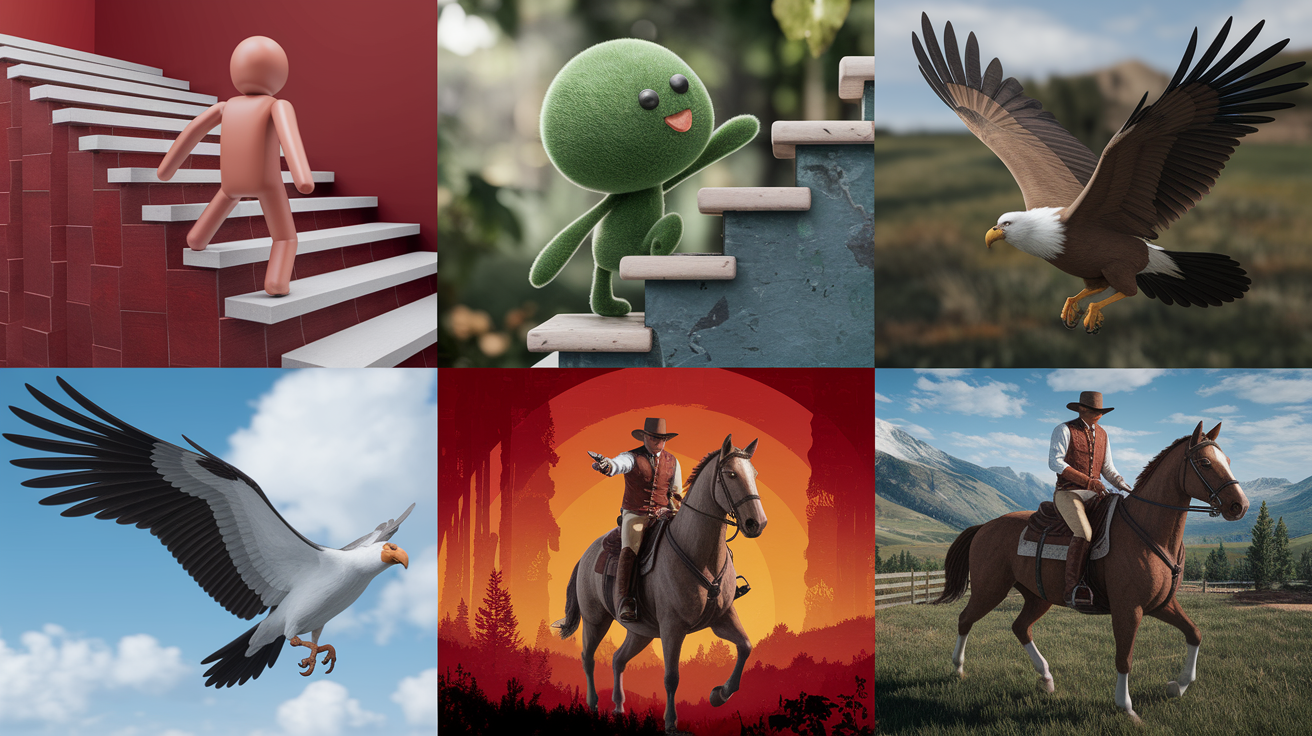
Ragdoll physics systems demonstrate fundamental procedural realism by simulating character death and impact responses through rigid-body dynamics rather than canned fall animations. Each body part becomes an independent physics object connected to neighbors by joint constraints that limit rotation ranges and apply spring forces. Unpredictable but believable collapses when characters lose motor control. Environmental interactions emerge naturally as limbs collide with stairs, furniture, terrain geometry. The physics solver calculates realistic tumbling, sliding, settling motion that varies with each death based on character velocity, impact angle, surrounding obstacles.
Grow Home’s protagonist BUD uses procedural locomotion where leg endpoints are driven by code-based target positions while limbs follow ragdoll-like joint constraints. Distinctive climbing and walking motion that adapts to any surface geometry. The system sets foot targets based on pathfinding and reachability analysis, then lets physics and IK propagate motion through the limb chains naturally. Emergent animation that conveys intention through procedural means. This approach eliminated traditional animation entirely for the main character, with all movement emerging from the interaction between target-driven endpoints and constraint-based propagation.
Rain World generates creature motion by combining endpoint-driven control with hinge-joint physics. AI systems position key body points while intermediate segments obey physics constraints to produce fluid, organic movement. A vulture’s wing motion emerges from this hybrid approach. The wing tip follows a procedurally calculated flight path while the wing bones connecting shoulder to tip flex and fold based on hinge constraints and aerodynamic forces. This technique creates varied, naturalistic animal behavior where dozens of species share the same underlying procedural framework parameterized differently for each creature’s anatomy and movement style.
Red Dead Redemption 2’s horse-riding mechanics adjust procedural animation parameters continuously based on terrain slope, surface material, rider input. Mount behavior that feels physically connected to the environment. The procedural system modifies gait timing, leg extension, body lean, head position in response to ground detection data. Distinct riding feels across mud, rock, grass, sand without requiring separate animation sets for each combination. Transitions between walk, trot, canter, gallop blend smoothly through procedural parameter interpolation rather than animation crossfades, maintaining natural motion cadence across speed changes and terrain variations.
Final Words
Jump straight into practical use: procedural animation is algorithm-driven motion, using IK, noise, constraint solvers, and behavior rules that run at runtime and adapt to the scene.
This post showed why that matters: adaptive foot placement, ragdoll reactions, emergent crowds, secondary motion, plus the math, performance tips, and workflows to ship it.
If you still wonder what is procedural animation and how it improves realism, think of it as systems that let characters react to the world in real time. Blend it with hand-crafted clips and you’ll get believable motion faster.
FAQ
Q: What is procedural animation?
A: Procedural animation is algorithm-driven motion generation that uses rules, noise, or math to create movement at runtime or during simulation, enabling adaptive, reusable, and dynamic animations.
Q: What is the purpose of realism in animation?
A: The purpose of realism in animation is to make movement feel believable, boost immersion and player feedback, and ensure characters and environments react convincingly to actions and forces.
Q: How is procedural animation different from traditional animation?
A: Procedural animation is different from traditional animation by generating motion through algorithms at runtime, while traditional animation relies on handcrafted keyframes or motion capture that produce fixed, precomputed sequences.
Q: What are the 4 types of animation?
A: The four types of animation are traditional (hand-drawn), 2D digital (vector/flash), 3D CGI (computer-generated), and stop-motion (physical frame-by-frame models), commonly used across film, games, and web.