

Think crossplay is just “let players on different platforms play together”?
Think again.
Crossplay matchmaking hides a tangle of mismatched APIs, network rules, auth tokens, anti-cheat limits, and input fairness problems that developers deal with every day.
This post explains the real, technical challenges behind crossplay matchmaking and why they slow releases, add latency, and cause broken sessions.
You’ll get a clear view of the biggest pain points: translation layers, tick-rate mismatch, token mapping, policy conflicts, and cheat detection gaps, plus practical ways teams reduce risk and keep matches working.
Core Technical Barriers in Crossplay Matchmaking
Platform API mismatches force developers to build translation layers that convert incompatible data formats on the fly. Each platform uses its own SDK with unique data structures for player sessions, lobby state, and matchmaking requests. When a PlayStation client sends a lobby invitation packet, the backend has to reformat that data into something Xbox or Steam can actually read, then reverse everything for responses. These translation layers add latency, raise the risk of data corruption during conversion, and need constant updates whenever a platform vendor tweaks its API. Authentication tokens, party metadata, even timestamp formats? They rarely line up across platforms. So developers maintain complex mapping tables and versioned converters just to keep sessions working.
Synchronization gets messier when platforms enforce different tick rates, compression models, or latency tolerance windows. A PC client running at 128 tick expects state updates every 7.8 milliseconds. A mobile client might operate at 30 tick with a 33-millisecond update cycle. When these clients share a match, the authoritative server has to interpolate or buffer states to prevent visible desync. But buffering adds perceived lag and interpolation can cause hitbox misalignment. Compression algorithms also differ. Some platforms mandate proprietary codecs for bandwidth reduction, while others allow standard zlib or custom schemes. Mismatched compression creates decode failures or forces the server to maintain multiple encoded copies of the same game state, multiplying bandwidth and CPU costs.
Fragmented authentication systems generate token mismatches and inconsistent identity verification. PlayStation Network, Xbox Live, Steam, and Epic Online Services each issue their own OAuth tokens with different claim structures, expiration policies, and refresh mechanisms. A crossplay matchmaking service has to validate tokens from all vendors at once, map disparate user IDs to a unified internal profile, and handle cases where a player links multiple platform accounts or unlinks mid-session. Token expiration during a match can silently disconnect a player unless the backend implements token refresh polling. But platforms enforce rate limits on refresh requests. Cross-account bans and entitlement checks add another layer. A player banned on one platform may stay valid on another unless the developer maintains a centralized ban list and propagates it across all authentication endpoints.
Networking Architecture Constraints Across Platforms

Platforms rely on different packet rules, transport protocols, matchmaking latency thresholds, and NAT traversal standards. A single network stack rarely works everywhere. Console SDKs often enforce strict UDP delivery guarantees or packet-size ceilings that PC clients ignore, and mobile networks introduce variable jitter that breaks assumptions about round-trip stability.
Cross-platform matchmaking hits these networking trouble points constantly:
- UDP reliability policies differ. Some platforms drop out-of-order packets by default, while others queue and reorder, causing state drift when mixed.
- NAT traversal inconsistencies mean STUN/TURN success rates vary. Consoles behind symmetric NAT may fail hole-punching that works for PC clients.
- Variable MTU sizes force fragmentation. Mobile carriers cap at 1280 bytes, but PC Ethernet allows 1500, so the server has to detect and adjust per client.
- Latency balancing methods clash when one platform prioritizes low ping and another prioritizes stable ping. Matchmaking algorithms have to choose which metric to optimize.
- Platform-specific relay server paths add hops. Xbox may route through Azure, PlayStation through proprietary relays, and PC through direct paths, creating asymmetric route costs.
Developers work around these constraints by building a platform-agnostic network layer that detects the client’s environment at handshake, negotiates the lowest-common-denominator MTU, selects transport mode (reliable ordered vs unreliable unordered), and switches between direct connections and relays when NAT punching fails. This abstraction layer also has to normalize latency measurements across platforms because some SDKs report one-way trip time while others report round-trip, making fair matchmaking impossible without conversion. The result is a compatibility shim that increases code complexity and requires per-platform testing to catch edge cases like firmware updates that silently change NAT behavior.
Platform Policy and Certification Conflicts

Sony, Microsoft, Nintendo, and PC ecosystems impose unique compliance rules that affect matchmaking logic, data handling, and feature parity. These rules rarely align. PlayStation requires that crossplay be opt-in by default and that players can disable it in-game, but Xbox mandates opt-out to maximize pool size. This forces developers to implement dual toggle logic that remembers per-platform preferences. Nintendo restricts voice chat to approved middleware and blocks third-party friend integration, so a unified party system has to gracefully degrade features when Switch players join. PC platforms have no equivalent certification process, letting developers ship updates daily, but console patches face multi-week approval queues. When a critical matchmaking bug appears, PC can deploy a fix immediately while console players stay broken until the next synchronized release window, fragmenting the player base by version.
Data privacy requirements create further mismatches. Europe’s GDPR, California’s CCPA, and platform-specific policies dictate different data retention periods, consent flows, and cross-border transfer rules. A matchmaking service that caches player skill ratings has to purge European user data within 30 days of a deletion request, honor California users’ opt-out of sale (even if no sale occurs), and comply with PlayStation’s prohibition on sharing social graph data with non-Sony services. These rules require geo-fencing logic, per-region database shards, and consent SDKs that vary by platform. User-safety mandates add another layer. Xbox requires real-time text filtering for all chat, PlayStation mandates reporting tools with specific button placements, and mobile platforms enforce parental controls that can silently block matchmaking features. Developers have to build conditional flows that detect platform and jurisdiction, then enable or disable features at runtime, making sure no single build violates any rule while still delivering a coherent cross-platform experience.
Anti-Cheat Compatibility and Security Risks
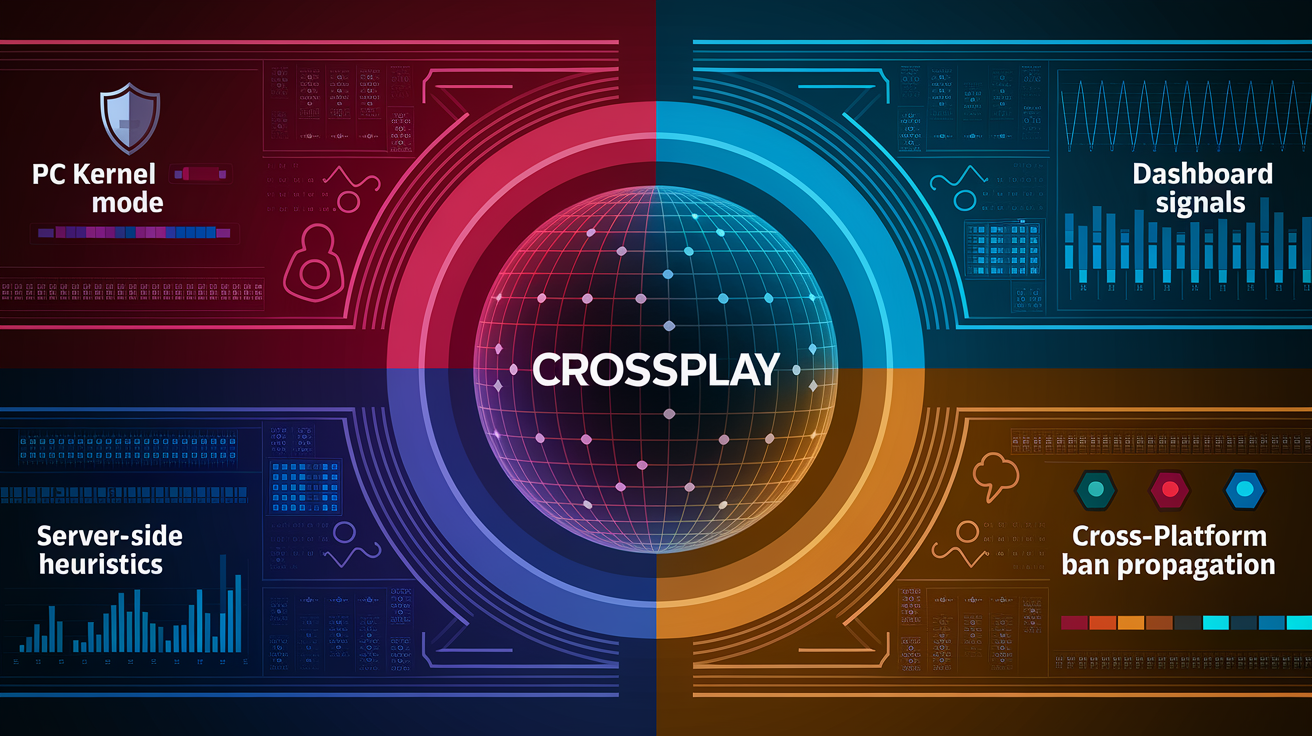
Anti-cheat engines often rely on kernel-level access on PC to inspect memory and intercept system calls, but consoles prohibit third-party kernel modules entirely. This creates a compatibility gap that requires fallback detection methods.
PC anti-cheat solutions like Easy Anti-Cheat or BattlEye load kernel drivers to detect memory editing, process injection, and virtualized environments. But PlayStation, Xbox, and Switch lock down kernel access and provide only user-mode APIs for telemetry collection. This forces developers to run different anti-cheat configurations per platform: kernel-mode on PC, user-mode behavioral analysis on consoles, and server-side heuristic checks on mobile. When a PC cheater joins a console lobby, the server has to reconcile conflicting confidence scores. PC clients report high-fidelity violation events, while console clients report only indirect signals like impossible movement speeds. Crossplay matchmaking then faces a choice: segregate platforms to preserve detection fidelity, or mix them and accept higher false-negative rates on the weaker detection side.
| System Type | Challenge Description |
|---|---|
| PC kernel-mode | Requires signed drivers, admin rights, and bypass of hypervisors. Consoles reject these entirely |
| Console user-mode | Limited to API hooking and log analysis. Can’t inspect arbitrary memory or block DLL injection |
| Server-side heuristics | Detects statistical anomalies but generates false positives. Must fuse client telemetry from mixed sources |
| Cross-platform ban propagation | Platforms enforce separate account systems. A Steam ban doesn’t auto-ban the same player’s Xbox account |
Input Method Balancing and Fairness Engineering

Mouse-keyboard vs controller inputs create aim-assist, recoil compensation, and movement discrepancies that directly influence matchmaking algorithms. Detecting input type in real time is harder than it sounds. Players can hot-swap devices mid-match, plug in a controller for movement, switch to mouse for aiming. So the matchmaking service has to either lock input method at queue time or continuously monitor active device and reassign the player’s skill bracket on the fly. Locking inputs reduces flexibility and frustrates players who prefer hybrid setups. But real-time reassignment requires low-latency telemetry, increases server CPU load, and opens exploits where players spoof input events to gain easier lobbies.
Engineering fair crossplay matchmaking around input devices involves three technical layers: input detection, matchmaking segmentation, and aim-assist calibration algorithms. Input detection polls platform APIs to identify active HID devices, but mobile touch events, console controller APIs, and PC DirectInput/XInput use incompatible event structures. The server relies on client-reported input type unless it can fingerprint input timing patterns (mouse polling rates vs controller analog curves). Matchmaking segmentation then splits queues by input class: keyboard/mouse pool, controller pool, and mixed pool. But smaller pools increase wait times, so developers often collapse pools dynamically when queue depth falls below a threshold, trading fairness for speed. Aim-assist calibration applies platform-specific multipliers. Console controllers receive rotational aim-assist to compensate for thumbstick precision loss, mobile touch gets magnetism and enlarged hitboxes, and PC mouse receives none. But these values need tuning per weapon and per range bracket to avoid over-correcting and creating new imbalances.
Infrastructure Load, Scaling, and Cross-Region Coordination

Crossplay increases concurrency loads because it merges previously separate platform queues into a single shared pool. That spike in simultaneous connections forces developers to normalize backend services to a single shared profile system. A game that previously ran 50,000 peak concurrent users per platform now handles 200,000+ when crossplay launches, overwhelming matchmaking services that were scaled for isolated ecosystems. Session state, party membership, and skill ratings that once lived in platform-specific databases have to migrate to a unified cross-platform store, requiring schema migrations, identity mapping, and real-time synchronization to avoid split-brain scenarios where a player’s rank differs between their PC and console profiles.
Infrastructure teams face these specific scaling and coordination challenges:
- Load balancing has to route matchmaking requests to regional clusters without creating platform-specific hot spots. Naïve hashing by user ID clusters one platform’s players on a few nodes.
- Cross-region matchmaking queues need shared visibility so a low-population region can pull from neighboring data centers, but WAN latency between regions adds 50 to 150 ms to state replication.
- Failover synchronization requires that session state replicate across availability zones in real time, but platforms differ in allowed replication targets (some prohibit data leaving specific geographic boundaries).
- Shared backend service requirements mean a single account service, friends service, and entitlement service has to handle authentication tokens, API rate limits, and data formats from five or more platform SDKs at once.
Auto-scaling policies become critical when crossplay launches or during peak events, but cloud providers charge for sustained connections. Over-provisioning costs multiply quickly. Developers configure horizontal pod autoscalers to spawn matchmaking workers when queue depth exceeds thresholds, but cold-start latency for new pods can reach 30 seconds, long enough to spike wait times and trigger player churn. Under-provisioning causes queue timeouts and forces players into higher-latency regions, degrading match quality and increasing complaints.
Final Words
We broke down the main bottlenecks: API mismatches that need translation, sync trouble from tick rates and latency, fragmented authentication, networking rules and NAT issues, platform policy differences, anti-cheat gaps, input fairness, and scaling strains.
Focus first on translation layers, unified auth, and tolerant sync, which fix most pain points. Use relays and region-aware queues to ease networking. Test early on mixed setups.
This post gave a clear, practical map of crossplay matchmaking technical challenges explained, so teams can prioritize fixes and keep players matched across platforms. It’s solvable. Step by step, you’ll get there.
FAQ
Q: How does crossplay work technically?
A: Crossplay works by translating platform APIs and data formats, synchronizing game state across different tick rates, and routing players through shared or relay servers while handling authentication and NAT traversal.
Q: Is it better to have crossplay on or off?
A: Having crossplay on is usually better for faster matchmaking and larger player pools; turn it off only if you want platform-only matches, lower latency, or to avoid input-fairness issues.
Q: Why is crossplay so laggy?
A: Crossplay is often laggy because cross-platform matches can add relay hops, mismatched tick rates, different packet rules, and varying NAT behavior, all of which increase latency and packet loss.
Q: Why are there so few cross-platform games?
A: There are few cross-platform games because platform certification rules, differing SDKs, anti-cheat conflicts, and extra engineering and testing costs make crossplay complex and expensive to build.