

Are many NFT blockchain game tokenomics designed to fail, or can they be fixed?
High inflation, short team vesting, and sudden hacks have wiped value from projects where token supply rose 10 to 30 percent a month.
This post breaks down the main risks, economic design and external shocks, and gives five clear indicators plus practical fixes to judge whether a game’s token model can survive long term.
Read on to learn what to watch, what to avoid, and how to spot projects with real staying power.
Core Risks and Long‑Term Viability Factors in NFT Game Tokenomics

NFT blockchain game tokenomics run into two main risk buckets: bad economic design and external shocks. Inflation’s the biggest systemic threat. When projects launch with uncapped or overly generous emission schedules, you’re looking at circulating supply growth pushing past 10 to 30 percent monthly. That crushes token price fast unless there’s proportional revenue or demand sinks to match it. If in-game rewards lean mostly on fresh token sales or continuous new players, the system starts looking like a Ponzi. Growth stalls, reward payouts can’t keep up, and prices tank.
Sell pressure adds another fragile layer. Team and investor allocations typically sit around 10 to 30 percent of total supply. Short vesting periods under six months create immediate downward force the second tokens unlock. Then there’s hacks and bridge failures. A bridge hack in March 2022 drained roughly $625 million and gutted player trust and token value in one shot. One technical failure wiped out months of economic stability.
Five sustainability indicators separate projects that’ll make it from ones that won’t:
- Treasury runway needs to cover reward emissions for at least 6 to 12 months at current DAU levels. Ideally part of that’s in stablecoins.
- Net circulating supply growth should stay under 5 percent monthly after the launch phase wraps.
- Team and investor allocation exposure: look for more than 12 months cliff or linear vesting. Avoid anything with more than 30 percent of supply immediately sellable.
- FDV versus market cap tells you what happens when locked tokens unlock. Calculate FDV as current price times total supply.
- On-chain flows: persistent net outflows to exchanges from team or treasury wallets signal sell pressure coming soon.
Long-term viability depends on balancing player spending with reward emissions. When in-game purchase flows and transaction fees exceed token issuance, the project can hold value. Treasury stability gives you the buffer to weather temporary demand shocks. Economic sinks, crafting fees, burns, consumable limits, capture token supply and stop runaway inflation.
Token Supply Architecture and NFT Game Tokenomics Stability

Token supply structure decides whether a game economy absorbs volatility or amplifies it. Fixed supply models cap total tokens, introducing artificial scarcity and tying value to demand. Inflationary models continuously mint new tokens to reward players, which creates downward price pressure unless you’ve got equivalent consumption or destruction happening. Mint on demand designs let developers inject supply as needed. That’s flexible, but it risks centralized manipulation and unpredictable dilution. Dual token architectures separate utility tokens used in-game from governance or asset tokens traded on exchanges. This can reduce immediate sell pressure by keeping daily rewards off open markets, but it adds complexity. UX friction goes up and economic coupling risks stick around.
Best practices center on three things: monthly net supply growth, vesting schedules, and initial allocation transparency. Net supply growth should stay below 5 percent monthly once the launch window closes. Team and investor vesting should stretch 12 to 48 months with a cliff to stop immediate dumps. Don’t launch with more than 30 percent of total supply immediately liquid. Concentrated early selling destabilizes price discovery and erodes trust. Short vesting under six months from team or investors causes early sell pressure that spirals into reflexive exits as early buyers race to get out before later cohorts.
| Model Type | Risk Level | Notes |
|---|---|---|
| Capped Supply | Medium | Scarcity supports value but depends entirely on sustained demand. No ability to adjust supply downward in crashes. |
| Inflationary | High | Continuous minting can outpace demand sinks and drive price to near zero without aggressive burn mechanisms. |
| Mint-on-Demand | High | Developer discretion enables rapid response to imbalance, but centralization and unpredictability erode player confidence. |
| Dual-Token | Medium-High | Separates in-game economy from speculative asset, but complexity confuses new users and coupling risks remain if conversion mechanisms exist. |
Failure Modes in NFT Blockchain Game Tokenomics
Inflation spirals are the most common collapse pattern. More players join, reward minting increases, circulating supply pushes higher, and downward pressure hits token price. Lower prices cut the real dollar value of rewards, which frustrates players into selling and exiting. That accelerates the decline. This feedback loop becomes self reinforcing when player counts grow faster than revenue or consumption sinks. ROI-NFTs that grant ongoing reward production, like breeding or passive yield mechanics, amplify the spiral by creating indefinite supply growth unless there’s caps or consumption costs to balance it. Historical examples include the breeding dynamics in a major 2021 game and similar issues in other projects where unchecked reward loops led to rapid token devaluation.
Reflexive boom bust cycles happen when rising prices attract speculators chasing short term gains instead of long term gameplay. During the boom phase, token price appreciation draws capital from investors and guilds who acquire large stakes at early discounts. Retail participants enter later at higher prices, mistaking speculative momentum for fundamental value. When growth plateaus or negative news surfaces, early holders exit quickly. That triggers a cascade of selling. Falling prices accelerate exits as players try to avoid being the last to sell, creating a liquidity trap where sell orders vastly outnumber buyers. Reflexivity turns token markets into musical chairs. Late participants absorb severe losses.
Farming and botting dynamics accelerate inflation and concentrate value extraction. Automated scripts and bot farms claim rewards at scale, minting tokens far faster than organic player activity would generate. Because bots have negligible attachment to the game or community, they sell rewards immediately to cover operational costs. That creates relentless sell pressure. Manual grinding by players optimizing for maximum token yield rather than enjoyment produces similar effects. When a significant portion of the player base treats the game as a job rather than entertainment, the system becomes dependent on constant new user inflows to absorb selling from yield farmers.
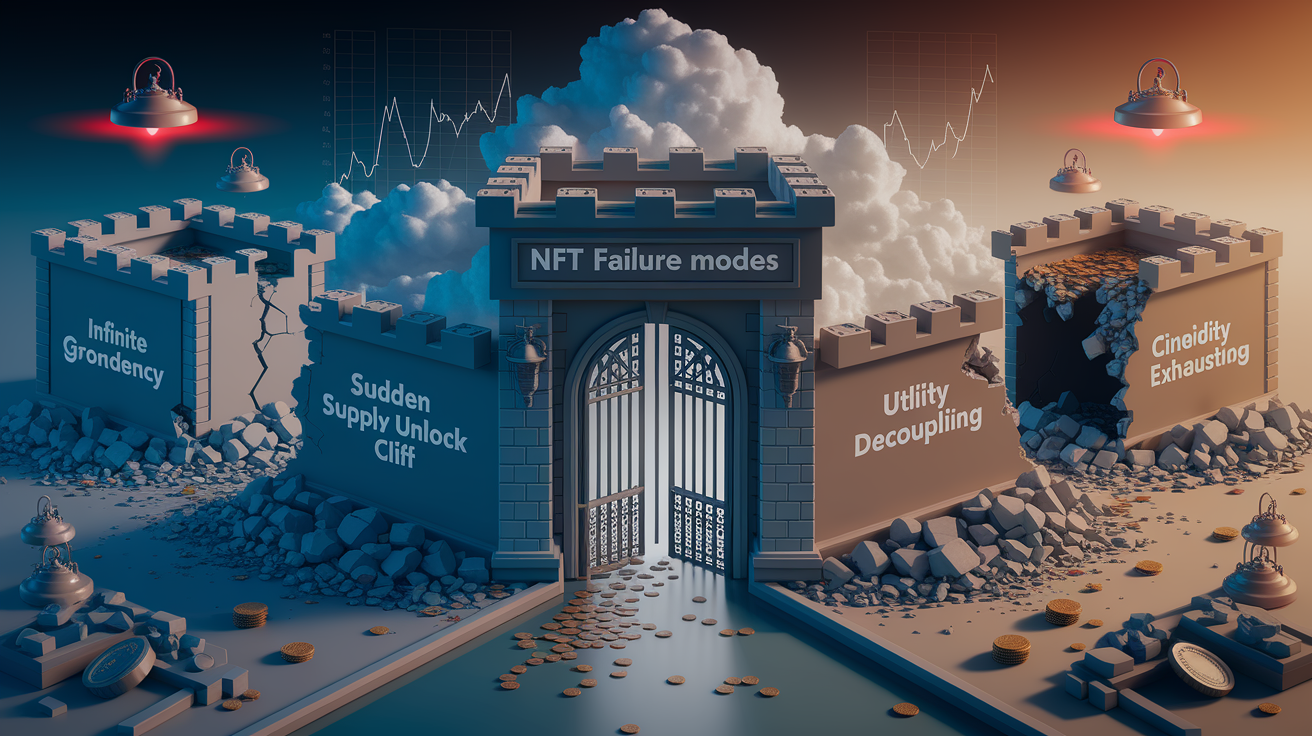
Four collapse patterns keep showing up in failed NFT game economies:
- Infinite growth dependency: reward payouts funded by new user token purchases collapse when user acquisition slows or reverses.
- Supply shock unlock events: large token cliffs from team, investor, or early player vesting create concentrated sell pressure that overwhelms liquidity.
- Utility decoupling: tokens designed primarily for speculation rather than meaningful in-game utility lose value when speculative interest fades.
- Liquidity exhaustion: shallow on-chain liquidity pools magnify volatility, causing price to plummet on moderate sell volume and trapping holders in illiquid positions.
Token Utility, Demand Drivers, and Sustainable NFT Game Economies

Meaningful utility ties token value directly to gameplay health. Utility tokens need to serve essential in-game functions. Purchasing consumables, unlocking features, facilitating upgrades. That creates organic demand independent of speculative trading. Governance tokens gain value when holders can influence roadmap decisions, economic parameters, or revenue distribution. But governance alone rarely sustains value without additional in-game use cases. When a token’s primary appeal rests on speculative appreciation rather than functional demand, price becomes detached from player engagement and vulnerable to sentiment swings. Projects that layer multiple utility types, combining consumable purchases, staking yields, and governance rights, build more resilient demand profiles.
Economic sinks balance faucets by removing tokens or NFTs from circulation. Crafting fees require players to burn tokens when upgrading equipment or creating new items. Cosmetic purchases, skins, emotes, visual effects, generate revenue without creating pay-to-win imbalances and can be priced to capture significant player spending. Subscription models provide recurring revenue streams that fund development and buyback programs without inflating supply. Tournament buy-ins and repair costs introduce time limited consumables that must be replenished, creating continuous demand. Revenue first systems that dedicate 2.5 to 10 percent of marketplace fees to automatic buyback and burn mechanisms or reserve stablecoin treasuries act as deflationary stabilizers, offsetting reward emissions with proportional supply destruction.
High impact sink mechanisms that improve long term sustainability:
- Marketplace fee capture directing 2.5 to 5 percent of secondary sales to automatic buyback and burn contracts.
- Limited supply consumables that degrade or expire, forcing repeat purchases for competitive play.
- Non-tradable cosmetics purchased with native tokens, converting speculative holdings into permanent in-game personalization.
Security Vulnerabilities and Technical Risks Impacting NFT Tokenomics

Smart contract failures and bridge exploits can destroy economic value overnight. The March 2022 bridge hack that drained roughly $625 million from a major NFT game caused a steep collapse in token price and player trust. Bridge vulnerabilities arise because cross-chain protocols rely on complex lock and mint mechanics that introduce multiple attack surfaces. When an attacker drains escrowed funds or mints unbacked tokens on the destination chain, the resulting supply shock and loss of confidence trigger reflexive selling. Smart contract bugs, reentrancy attacks, integer overflows, access control flaws, can similarly drain treasuries or mint unlimited tokens, rendering economic models worthless.
Market MEV, miner extractable value, and oracle dependency risks destabilize reward systems. MEV allows validators or searchers to reorder, insert, or censor transactions for profit. Front running player trades or manipulating in-game auction outcomes. Oracle failures or manipulations can feed incorrect price data into smart contracts, causing automated buyback mechanisms to execute at unfavorable rates or reward calculations to skew. These technical risks compound economic design flaws. A poorly designed emission schedule becomes catastrophic when combined with an oracle exploit that artificially inflates reward payouts.
Multi signature treasury controls and regular security audits reduce catastrophic losses. Multi sig wallets require multiple authorized signers to approve withdrawals, preventing single points of failure or insider theft. Insurance funds, reserves held in stablecoins or diversified assets, provide a buffer to compensate players or stabilize markets after an exploit. Bug bounty programs incentivize white hat researchers to identify vulnerabilities before malicious actors exploit them. On-chain monitoring tools track unusual transaction patterns, large treasury outflows, or abnormal minting events, enabling rapid response to emerging threats. Together, these practices form a layered defense that protects both technical infrastructure and economic stability.
Regulatory, Legal, and Compliance Considerations for NFT Game Tokenomics

Reward tokens marketed as investments with profit expectations risk classification as securities under securities laws in multiple jurisdictions. When developers emphasize staking yields, price appreciation potential, or revenue sharing mechanisms in promotional materials, regulators may determine that the token functions as an investment contract. Securities classification triggers registration requirements, disclosure obligations, and restrictions on who can purchase or trade the token. Non compliance can result in enforcement actions, fines, and forced buybacks that destabilize the entire economy. To reduce exposure, projects should emphasize utility and gameplay value over investment returns, avoid guaranteed yield promises, and seek legal counsel before launch.
Players earning tokens through play to earn mechanics face tax reporting obligations in many jurisdictions. Income from in-game rewards may be taxable as ordinary income at the time of receipt, with subsequent sales triggering capital gains or losses. Unclear or inconsistent tax guidance increases counterparty risk, as players may underreport income or fail to comply, creating future liabilities. AML and KYC requirements can conflict with UX ease. Regulators require platforms facilitating token to fiat conversion to verify user identities and monitor transactions for suspicious activity. Mandatory KYC creates friction for players seeking pseudonymity or operating in regions with limited identity infrastructure, but omitting KYC exposes projects to regulatory sanctions.
| Risk | Impact | Mitigation |
|---|---|---|
| Securities Law Exposure | Forced buybacks, fines, restricted distribution, loss of exchange listings | Emphasize utility over investment. Avoid yield guarantees. Obtain legal opinion |
| AML Obligations | Regulatory sanctions, platform shutdowns, loss of fiat on-ramps | Implement KYC for high value transactions. Partner with compliant exchanges |
| Tax Complexity | Player confusion, underreporting, future liabilities, reduced participation | Provide clear tax guidance. Integrate reporting tools. Educate users on obligations |
Environmental and Infrastructure Sustainability in NFT Game Tokenomics
Energy consumption concerns dominated early NFT and blockchain gaming criticism. Proof of work networks required massive computational resources. Ethereum’s pre-Merge energy footprint was comparable to that of a small country. The Ethereum Merge on September 15, 2022 transitioned the network to proof of stake consensus, cutting power use by an estimated 99.95 percent. This milestone significantly reduced environmental objections for projects building on Ethereum or compatible PoS chains, enabling developers to position their games as energy efficient without sacrificing security or decentralization.
Gas fee economics and layer 2 scaling solutions directly affect economic viability and user experience. On Ethereum mainnet, transaction fees during peak congestion historically ranged from several dollars to over one hundred dollars per action. That made frequent microtransactions economically unfeasible for most players. High gas costs force players to batch actions or avoid on-chain interactions, reducing engagement and liquidity. Layer 2 networks, rollups, sidechains, and state channels, reduce per transaction costs from dollars to fractions of a cent while inheriting mainnet security guarantees. Projects deploying on L2 solutions improve UX for frequent crafting, trading, and reward claiming, lowering the barrier to entry and enabling more granular economic interactions.
Layer 2 benefits for NFT game tokenomics:
- Transaction costs drop to cents or fractions of a cent, enabling high frequency in-game actions without prohibitive fees.
- Throughput increases by orders of magnitude, supporting larger player bases and more complex on-chain economies.
- User experience improves through near instant finality and reduced wait times, making blockchain interactions feel comparable to traditional game servers.
Quantitative Metrics and Economic Modeling for NFT Tokenomics

Simulation and data analytics predict long term sustainability by stress testing economic assumptions before live deployment. Agent based economy testing models individual player behaviors, buying, selling, staking, farming, and simulates emergent market dynamics over thousands of iterations. Monte Carlo stress testing runs hundreds or thousands of scenarios with randomized inputs, player growth rates, token prices, sell rates, to identify parameter ranges that lead to stability or collapse. These techniques reveal fragile points in tokenomics designs and quantify the impact of changes to emission schedules, vesting periods, or sink strength.
Key metrics provide real time health signals for live economies. DAU, daily active users, tracks engagement levels and serves as a leading indicator for reward demand. D1, D7, and D30 retention percentages measure how many players return after one, seven, and thirty days. That shows whether the core gameplay loop sustains interest beyond initial novelty. ARPU, average revenue per user per day, quantifies how much value players contribute through purchases or fees. LTV/CAC, lifetime value divided by customer acquisition cost, determines whether the project can profitably acquire and retain users. FDV versus market cap highlights potential dilution risk by comparing fully diluted valuation, current price times total supply, to circulating market cap. On-chain exchange flows track net inflows or outflows from team and treasury wallets to centralized exchanges, signaling imminent selling pressure or accumulation.
Developer best practices include modeling halving schedules that reduce emission rates at predetermined intervals, similar to Bitcoin’s supply halvings, to counteract long term inflation. Treasury runway should be calculated conservatively, assuming zero revenue growth and current DAU levels, to ensure at least six to twelve months of operational buffer. Extreme scenarios, zero revenue, mass unstaking, coordinated exits, should be modeled explicitly rather than relying on averaged assumptions. Real world shocks rarely follow smooth distributions. Buyback models, such as Vault systems that use in-game ETH revenues to purchase tokens from liquidity pools, show price stabilization only when reward payouts scale proportionally with actual revenue rather than guaranteed minimums.
Essential KPIs to monitor continuously:
- Treasury runway in months at current burn rate and DAU.
- Net token supply growth rate per month, accounting for emissions and burns.
- Exchange net flows from known team, investor, and treasury addresses.
- Retention cohorts (D1/D7/D30) and how they trend week over week.
Case Studies of Tokenomics Successes and Collapses in NFT Games
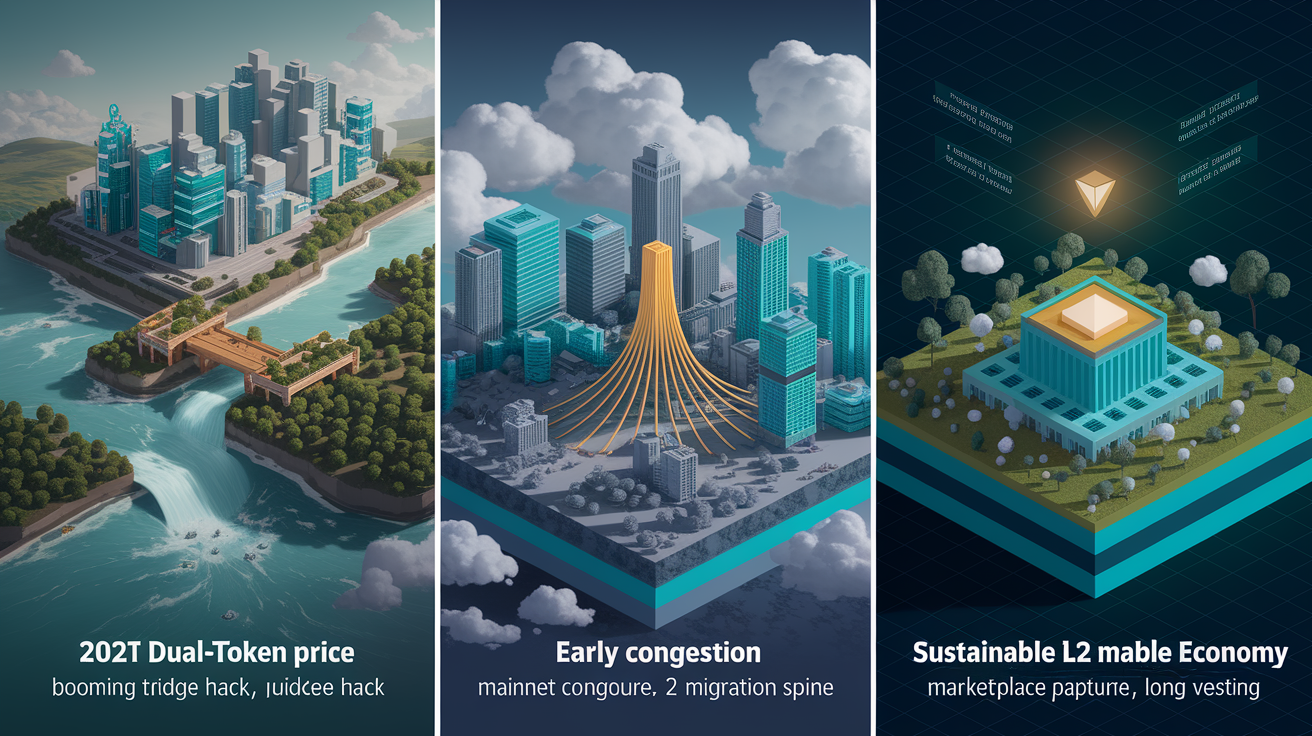
A major NFT game peaked in 2021 with massive daily active user counts and became the largest crypto application by revenue. The project introduced a dual token model with a utility token for breeding and an asset token for governance and staking. Rapid growth attracted scholarship guilds and investors, driving token prices to all time highs. In March 2022, a bridge hack drained approximately $625 million, directly undermining player trust. The utility token subsequently collapsed due to unchecked inflation from breeding mechanics and persistent exchange sell pressure from early holders. The case shows how a single technical failure combined with poor emission controls can unravel months of economic momentum and erode billions in market capitalization.
An early NFT collectible game created severe mainnet congestion in its initial launch phase, with transaction volumes overwhelming Ethereum’s capacity and driving gas fees to extreme levels. Players attempting to mint or trade NFTs faced prohibitive costs and multi hour confirmation delays. Infrastructure and UX limitations of mainnet only deployments became obvious. The project eventually migrated features to layer 2 solutions and introduced fixed fee marketplaces to stabilize costs, but the early congestion event damaged its reputation and demonstrated the importance of scalable infrastructure planning before launch.
Sustainable aligned models adopted proof of stake chains or layer 2 networks from the outset, avoiding high energy consumption and gas fee volatility. These projects implemented marketplace fee capture mechanisms, dedicating 2.5 to 5 percent of secondary sales to automatic buyback and burn contracts. Long term vesting schedules for team and investor allocations, ranging from 12 to 48 months, prevented early dumps and aligned incentives with project longevity. Fixed fee structures for minting and trading reduced user friction and created predictable revenue streams that could fund ongoing development and economic stabilization efforts.
| Project | Outcome | Key Lesson |
|---|---|---|
| 2021 Dual-Token Game | Rapid growth followed by collapse after bridge hack and inflation spiral | Technical security and emission controls are both critical. A single failure in either can trigger systemic collapse |
| Early Collectible Game | Severe mainnet congestion, high gas fees, eventual L2 migration | Infrastructure scalability and gas fee planning must precede mass adoption to avoid UX breakdowns |
| Sustainable L2 Model | Stable operation with marketplace fee capture, long vesting, and PoS deployment | Revenue first design, transparent vesting, and low energy infrastructure support long term viability |
Design Strategies and Best Practices for Sustainable NFT Game Tokenomics
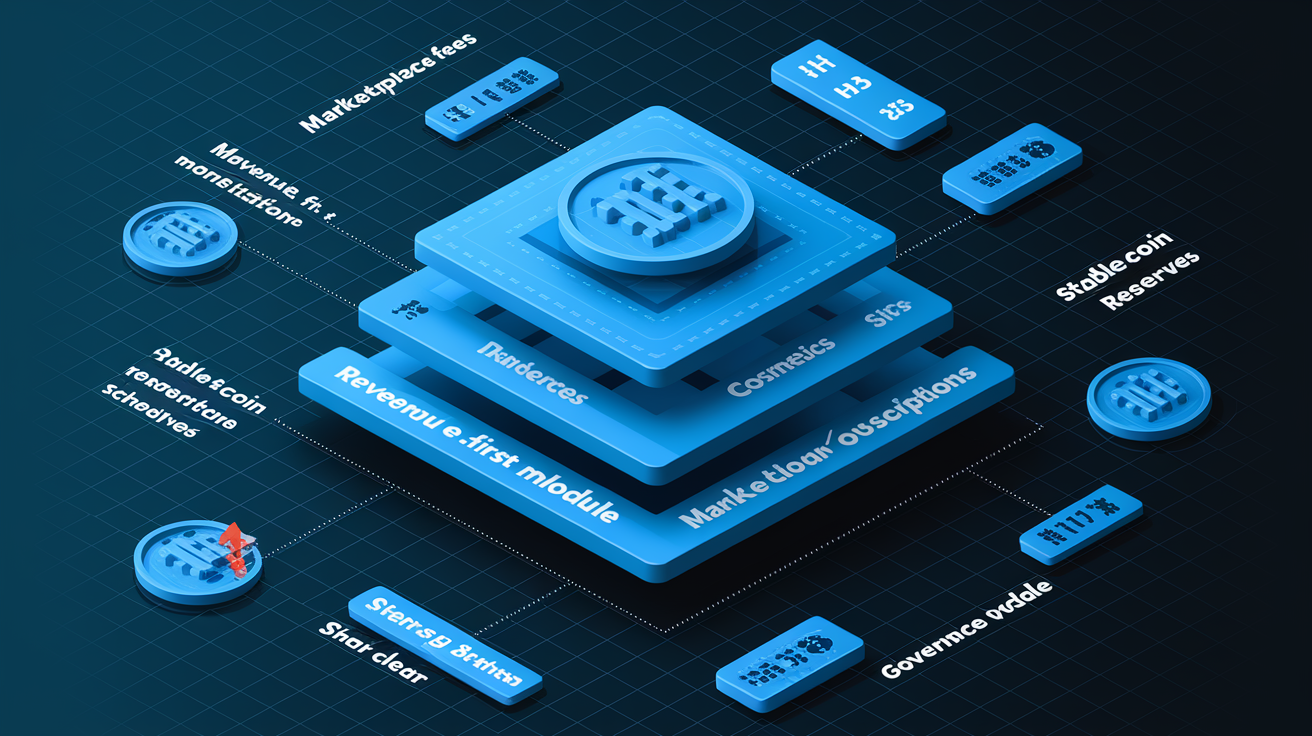
Revenue first structures prioritize durable cash flows over speculative token appreciation. Marketplace fees, typically 2.5 to 10 percent of secondary sales, generate income denominated in stablecoins or native tokens that can fund buyback and burn programs or be held as treasury reserves. Cosmetic and subscription revenues provide recurring income without creating pay to win imbalances. Free and paid players can compete on relatively equal terms while still monetizing engagement. Tournament entry fees and consumable sales create time limited demand that scales with player activity, automatically adjusting to match community size.
Decaying emission schedules reduce long term inflation by tapering reward rates over time. Halving like steps that cut emission rates by 50 percent every 12 months create predictable supply curves and signal to investors that dilution will decline. Continuous negative exponential decay offers smoother transitions and avoids the volatility spikes that can occur at discrete halving events. Stablecoin based or hybrid reward systems reduce player income volatility by denominating a portion of rewards in pegged assets, though this shifts revenue risk onto developers who must ensure sufficient stablecoin reserves to honor payouts during token price declines.
Multi layered security and treasury practices protect both code and capital. Multi signature wallets require multiple authorized signers, typically 3 of 5 or 5 of 9 configurations, to approve withdrawals, preventing single points of failure or insider theft. Regular third party audits by reputable firms identify smart contract vulnerabilities before malicious actors exploit them. Bug bounty programs offer financial incentives to white hat researchers, crowdsourcing security review. On-chain monitoring tools track unusual transaction patterns, flagging large treasury outflows, abnormal minting events, or concentrated exchange deposits for immediate investigation. Emergency funds equal to several months of treasury outflows provide a buffer to stabilize markets or compensate users after an exploit.
Top best practices for sustainable NFT game tokenomics:
- Scale sinks with faucets: ensure in-game burning mechanisms grow proportionally to reward minting, using dynamic fee adjustments or consumption requirements tied to player count.
- Implement long term vesting: lock team and investor allocations for 12 to 48 months with cliff periods to prevent early dumps and align incentives with long term success.
- Denominate treasury reserves in stablecoins: hold at least 30 to 50 percent of operational runway in stable assets to stabilize payouts during token price volatility.
- Adopt revenue first monetization: prioritize marketplace fees, cosmetics, subscriptions, and tournament buy-ins over speculative token sales to create durable cash flows.
- Model extreme scenarios: stress test tokenomics against zero revenue, mass unstaking, and coordinated exits rather than relying solely on averaged behavior assumptions.
- Maintain transparent on-chain metrics: publish real time dashboards showing treasury balances, emission rates, vesting schedules, and liquidity depth to build trust and enable informed decision making.
Final Words
We laid out the main hazards: runaway token inflation, reward loops that need endless new players, security failures, and legal exposure.
We also gave concrete metrics—treasury runway, DAU trends, vesting schedules—and practical fixes like sinks, buyback-burns, L2 scaling, and multisig treasuries.
Watch measurable thresholds (monthly supply growth, liquid allocation, retention) and stress-test scenarios.
With disciplined design and the right data, NFT blockchain game tokenomics risks and sustainability can be managed, so builders and players both win.
FAQ
Q: What are the risks of NFT?
A: The risks of NFTs are financial loss from price volatility, scams and wash trading, illiquid markets, smart-contract bugs, rug pulls, unclear royalties and regulatory or tax exposure for buyers and creators.
Q: Is NFT worthless now?
A: Whether an NFT is worthless now depends on the project: some retain strong demand and utility, while many speculative pieces fell. Check liquidity, floor-price trends, active users, and tokenomics before deciding.
Q: Are NFTs harmful to the environment?
A: NFTs’ environmental harm depends on the blockchain: proof-of-work networks used lots of energy, but Ethereum’s Merge cut consumption about 99.95% and proof-of-stake or layer-2 solutions now make NFTs far greener.
Q: What NFT sold for more than $500,000?
A: NFTs that sold for more than $500,000 include Beeple’s “Everydays” (millions), several CryptoPunks and Bored Ape Yacht Club pieces, plus high-value art and celebrity collections traded at seven-figure prices.