

Controversial: you can build massive, varied game worlds with a few lines of code.
Procedural generation is code that creates game content automatically instead of building every piece by hand.
It lets small teams make huge worlds, endless levels, or varied loot without storing every detail.
But that scale comes with a trade-off: less control over exact moments, harder testing, and a risk of boring repetition if you don’t design good constraints.
This post explains what procedural generation is, how it works, and when to use it so you get scale without losing the fun.
Core Explanation of Procedural Generation in Games and When to Use It
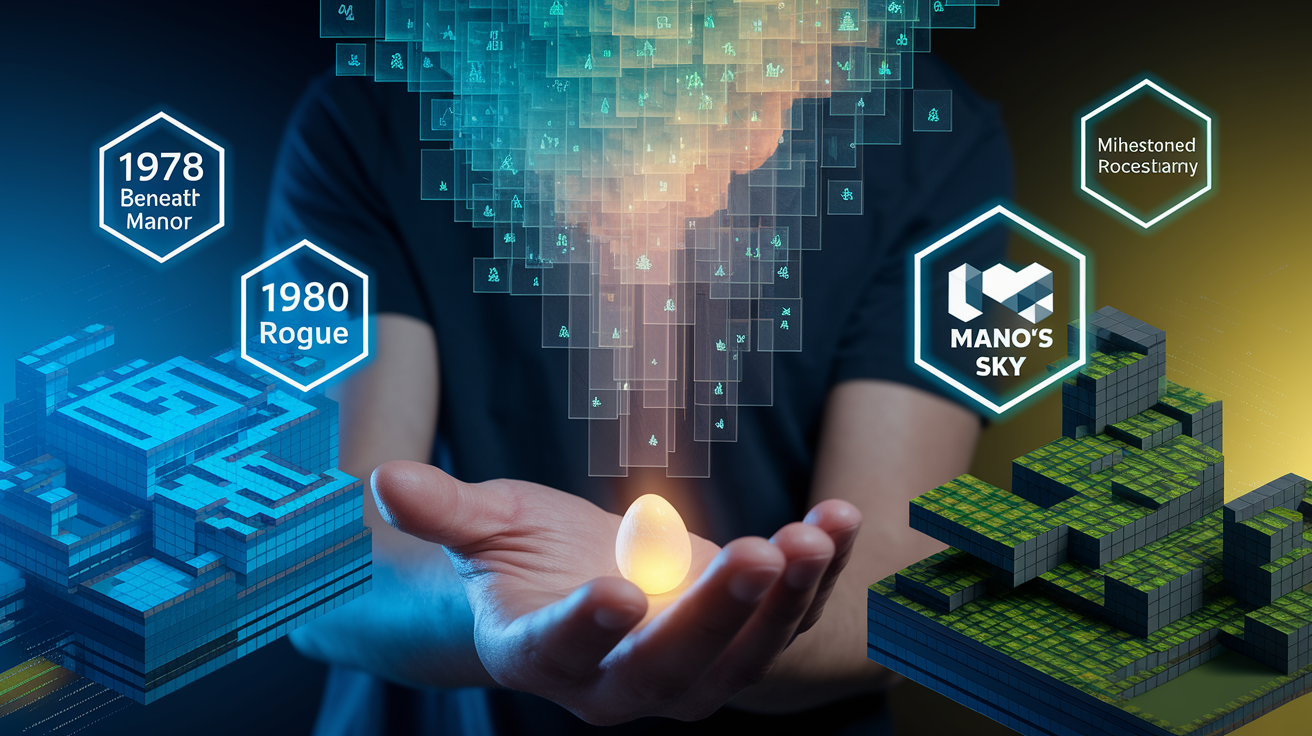
Procedural generation means using algorithms to create game content automatically instead of building every piece by hand. Rather than designers placing each tree or tile, procedural systems use code and math to generate environments, items, enemies, textures, and sometimes story elements on the fly or during build time. This goes back to 1978 with Beneath Apple Manor on the Apple II, a game running on just 16 KB of memory that produced levels with about 5 to 10 rooms each. By 1980, Rogue on Unix had popularized the approach so well that an entire genre got named after it.
Modern games like Minecraft, No Man’s Sky, and Terraria lean heavily on procedural generation to deliver massive, varied worlds that you couldn’t hand-craft at scale. Minecraft’s world is practically larger than planet Earth, while No Man’s Sky advertises a nearly infinite universe of “quadrillions” of unique planets. That kind of content volume shows what procedural generation does best: it lets small teams or solo developers create experiences with replayability, emergent variety, and storage efficiency. Because content can be reproduced from compact seeds and parameters instead of storing every detail, procedural worlds often load faster and take up less disk space than hand-built assets.
The benefits that make procedural generation attractive? Replayability through emergent variety across play sessions. Faster scaling of content production for large worlds or hundreds of levels. The ability to build roguelikes and sandbox games that thrive on unpredictability and exploration. It’s especially useful when a project has budget or time constraints, like the student team with essentially no budget and one semester to ship a game, where procedural generation became the only way to deliver enough content.
But it’s not always the right choice. You’re trading control for scale, making it hard to guarantee specific experiences or tightly tuned gameplay beats. Quality assurance gets more complex because you can’t manually test every possible generated case. Balancing difficulty or pacing is trickier when content varies. Procedural systems aren’t ideal for narrative-first games that need precise scripted moments, authored character arcs, or memorable set pieces. And they can produce repetitive or samey results if constraints and validation aren’t carefully designed. The ideal use cases include:
- Roguelikes and roguelike-inspired games that pair random levels with permadeath
- Very large open worlds where handcrafting isn’t feasible
- Texture, terrain, and foliage generation to reduce storage and increase variation
- Games prioritizing exploration and emergent gameplay over authored narrative
- Projects with tight budgets or small teams needing to scale content quickly
Foundational Techniques Behind Procedural Generation Systems
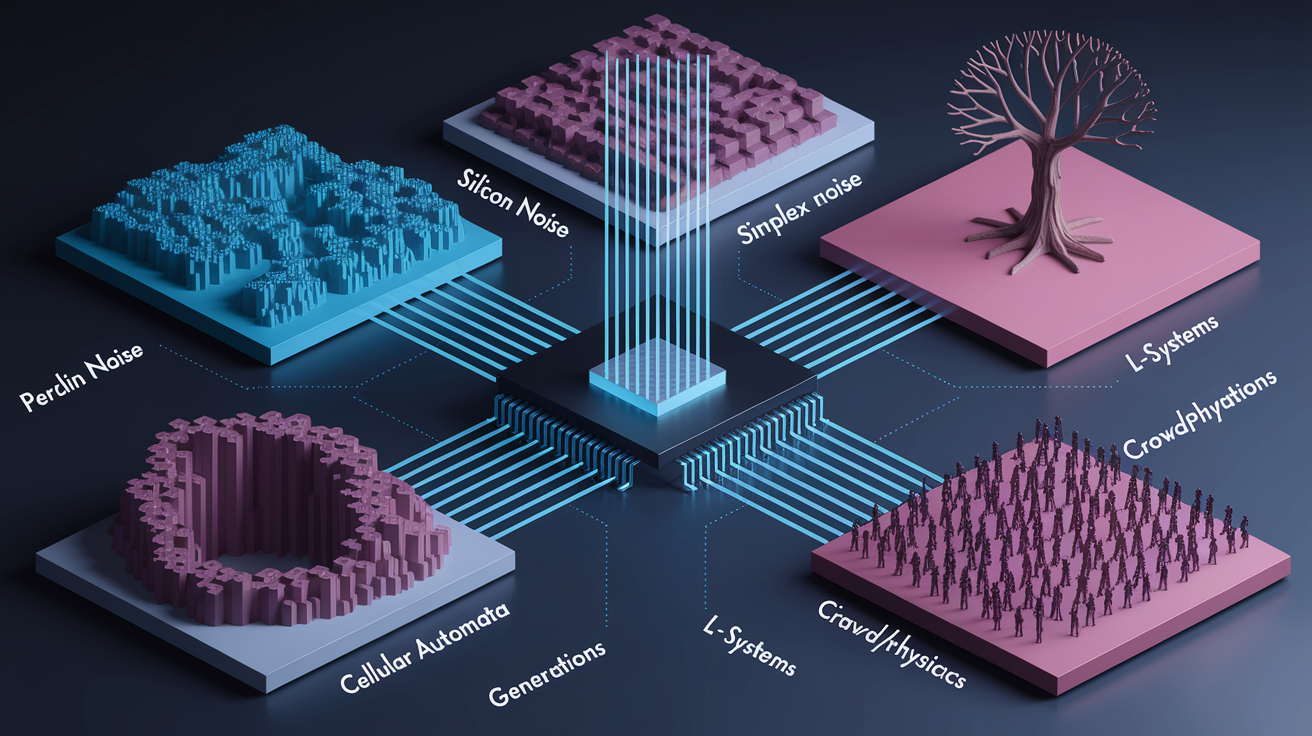
Procedural generation isn’t a single algorithm. It’s a collection of techniques, each suited to different content types and design goals. Classic algorithms like Prim’s Algorithm create labyrinthine mazes by carving passages through a grid, while noise functions provide the mathematical backbone for natural-looking variation. Perlin noise, first used in the original Tron film, remains a go-to for terrain generation, cloud textures, and any surface that should look organic rather than perfectly uniform. Simplex noise is a faster, more scalable variant often used in modern engines when performance matters or when generating content in higher dimensions.
For cave systems and organic dungeon layouts, cellular automata and random walks are popular. Cellular automata apply simple rules to a grid over multiple passes, turning noise into connected caverns. Random walks trace winding paths through a space, carving tunnels and chambers that feel more natural than strictly geometric rooms. When structure and coherence are needed, grammars and rule-based systems step in. L-systems generate branching structures like trees or cities by recursively applying rewrite rules, while procedural grammars can assemble architecture or story fragments from templates. Simulations add another layer. Erosion models reshape terrain over time, crowd dynamics populate cities with believable movement, and physics-based systems handle everything from destructible environments to fluid dynamics.
Generative AI has emerged as a powerful new technique, capable of creating high-level assets like textures, dialogue, or even level layouts from learned patterns. It raises control and ethical questions, especially around IP provenance and unpredictability, but when used with guardrails and validation, it can speed up content pipelines. The choice of technique should always match the use case. Noise for naturalistic surfaces. Algorithms like Prim’s for structured layouts. Simulations for dynamic or emergent content. Generative AI for asset variation when you have the tooling to constrain and test outputs.
| Technique | Primary Use |
|---|---|
| Perlin / Simplex Noise | Terrain heightmaps, natural textures, cloud patterns |
| Cellular Automata | Organic cave systems, clustered features |
| L-Systems & Grammars | Branching structures (trees, cities), architectural forms |
| Simulations (Erosion, Crowds) | Dynamic terrain shaping, believable NPC behavior |
Procedural Generation Algorithms in Action for Game Worlds & Levels
Understanding how procedural algorithms operate in real production helps demystify the process. Take Rogue’s approach from 1980. Levels were generated by dividing the map into rectangular regions, randomly placing rooms, then connecting them with corridors. That simple structure, executed with straightforward code, created enough variety to spawn an entire genre. Modern roguelikes still follow similar principles but add layers of constraint and post-processing to ensure playability. For example, one classic platformer implemented treasure placement in a single line of code. The probability of treasure on a ground tile was proportional to the number of adjacent solid surfaces, creating natural clustering near walls and corners without complex logic.
Deterministic seed-based generation is a cornerstone of many procedural systems. By feeding the same seed value into a pseudorandom number generator (PRNG), you can reproduce identical worlds across sessions or share specific maps with other players. Minecraft uses this to let players share world seeds, and speedrunners rely on known seeds to practice consistent routes. The seed-based approach also simplifies debugging. Developers can revisit and analyze a specific generated case rather than chasing a phantom bug through infinite permutations. Hybrid templates improve consistency further. Instead of generating everything from scratch, many games author small, hand-tested chunks or rooms and then arrange or modify them procedurally, balancing uniqueness with reliability.
Practical generation often follows a multi-step flow:
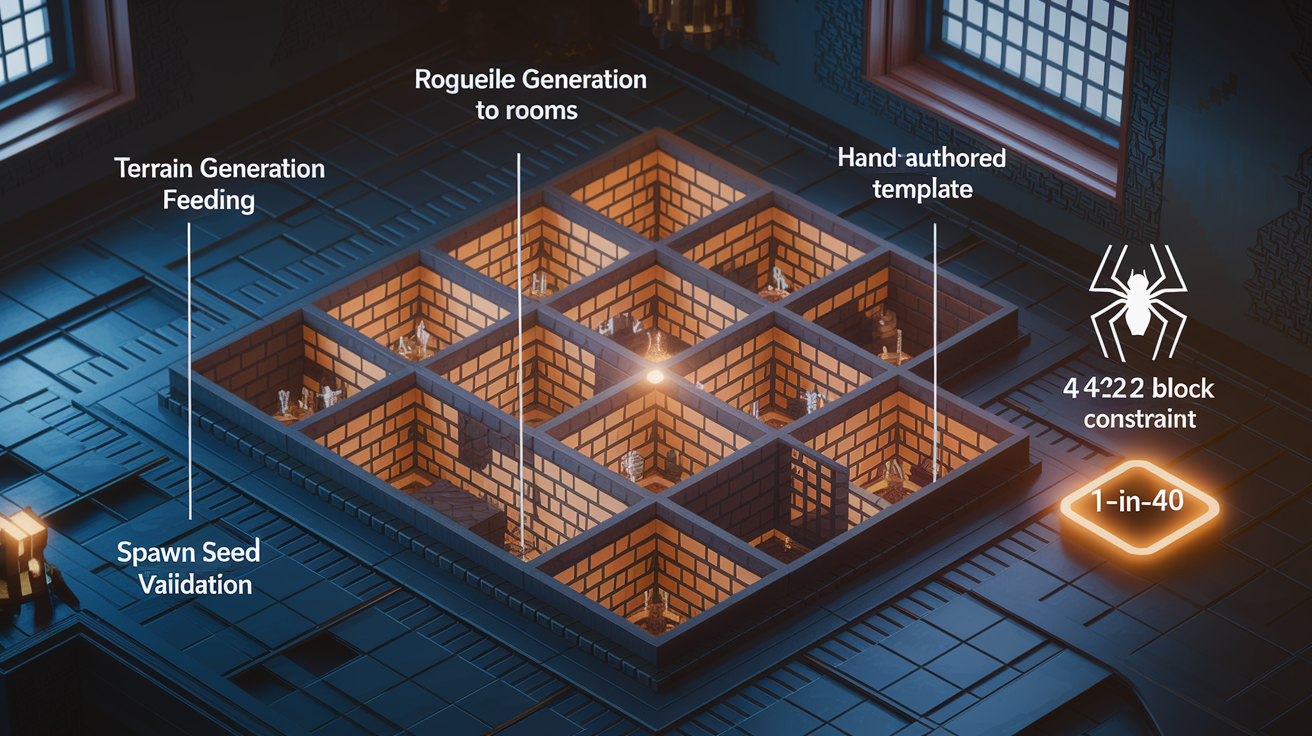
- Terrain generation – Apply noise functions to generate a heightmap or base topology, then post-process with erosion or smoothing to add realism.
- Room and structure layout – Use space-partitioning (like Binary Space Partitioning) or grammar rules to place rooms, corridors, or building footprints.
- Spawn rules and entity placement – Apply simple probability checks and adjacency tests to place enemies, treasures, or interactive objects in valid locations.
- Seed selection and validation – Choose or generate a seed, run validation passes to ensure traversability and playability, then accept or reject the result.
This modular, layered approach keeps each step testable and reduces the risk of unpredictable interactions between systems. In Spelunky, a Giant Spider spawns only when a 2×2 empty block exists beneath certain bricks and passes a 1-in-40 chance check. Once spawned, no additional spiders appear in that level. That tiny constraint, implemented in roughly 30 lines of code, ensures variety without overwhelming the player.
Deciding When Procedural Generation Is the Right Choice
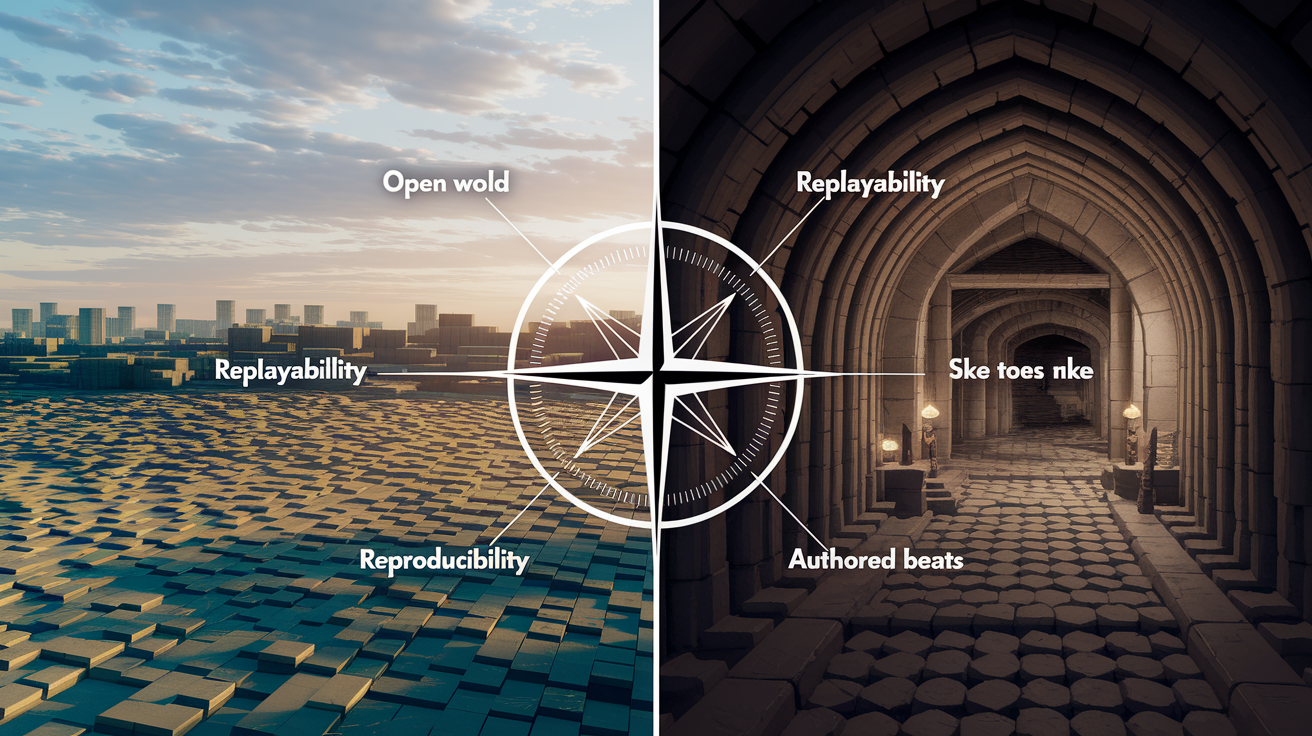
Procedural generation excels when your design calls for large content volumes, high replayability, or emergent variety that would be prohibitively expensive to hand-author. If you’re building a roguelike where every run should feel different, or an open-world sandbox where players explore for dozens of hours without seeing the same vista twice, procedural generation is often your best bet. It’s also a natural fit for texture and foliage systems, where thousands of unique tree models or rock formations would bloat storage and slow loading times. Indie developers and small teams frequently turn to procedural generation when budgets are tight and timelines are short, because it lets a handful of people produce content at a scale that would otherwise require a much larger art team.
The hybrid approach, combining hand-crafted anchor points with procedural filler, often delivers the best of both worlds. You can author key narrative beats, unique boss arenas, or carefully tuned tutorial sections by hand, then use procedural systems to generate the connective tissue, exploration zones, or ambient detail around them. This strategy reduces the authorial control problem while still benefiting from scale and variety. A dungeon crawler might hand-design the layout of a critical story level but procedurally populate it with enemy groups, treasure locations, and environmental hazards, ensuring each playthrough feels different even though the core structure remains constant.
You should lean toward procedural generation when:
- You need hundreds or thousands of levels, large open worlds, or massive texture libraries
- Content can tolerate variability and emergent outcomes without breaking intended gameplay
- Seed-based reproducibility or parameter-driven variation reduces storage or load times
- Replayability and exploration are core pillars of your design
- Your team lacks the resources to hand-author at the required scale
- You want to prototype quickly and iterate on parameters rather than rebuilding assets manually
Avoid procedural generation when your game demands tightly scripted pacing, authored narrative arcs, or precise puzzle layouts that must work exactly as designed. Story-driven linear games, competitive multiplayer maps requiring perfect balance, and skill-focused platformers with hand-tuned challenge curves all suffer when procedural unpredictability is introduced without strong constraints. If your team doesn’t have the skills or tooling to test and validate procedural outputs, or if your scope is small enough that manual polish is faster and more reliable, hand-authoring remains the better choice. The key question is always whether the benefits of scale, variety, or replayability outweigh the loss of fine-grained control and the added complexity of testing and iteration.
Limitations, Pitfalls, and Quality Control in Procedural Generation

Procedural generation introduces real risks when constraints and validation aren’t carefully managed. One of the most common complaints? Procedurally generated content feels repetitive or samey despite technically being unique. Daggerfall famously offered thousands of towns and hundreds of thousands of inhabitants across roughly 62,000 square miles, yet many locations felt undifferentiated because the underlying templates and generation rules lacked enough variation or authorial touch. No Man’s Sky faced similar criticism at launch, with players reporting that despite “quadrillions” of planets, most felt like palette swaps of the same biomes and structures. Fallout 4’s radiant quest system generated infinite side quests, but players quickly noticed they were permutations of the same templates, leading to a sense of grind rather than discovery.
Debugging and testing procedural systems is harder than validating hand-authored content. Because outputs are stochastic or depend on complex parameter interactions, you can’t manually check every possible case. Balancing becomes trickier when difficulty, pacing, or resource distribution can vary wildly between runs. Reproducibility is essential for iteration. Deterministic seeds let you revisit a specific generated world, but if your generator has hidden state or non-deterministic steps, tracking down bugs or tuning balance becomes a nightmare. Investing in validation passes, automated testing, and visualization tools early in development pays dividends by catching edge cases and nonsensical outputs before they reach players.
| Problem | Mitigation Strategy |
|---|---|
| Repetitive or samey content | Layer multiple generators, add hand-authored variety, use post-processing filters |
| Unplayable or broken layouts | Run validation passes (traversability, reachability), reject and regenerate failures |
| Difficult debugging and iteration | Use deterministic seeds, log generation parameters, build visualization tools |
| Loss of authorial control and pacing | Hybrid workflows: hand-author critical beats, procedurally generate surrounding content |
Tools, Engines, and Workflows Supporting Procedural Generation

Modern game engines and standalone tools offer extensive support for procedural generation, making it more accessible than ever. ShaderToy is a go-to platform for GPU-based procedural shaders and real-time visual experimentation, letting you prototype terrain, textures, or abstract effects in a browser and see results immediately. Blender’s Geometry Nodes provide a node-based workflow for procedural geometry, allowing artists to generate and modify meshes, scatter foliage, or build architectural modules without writing code. For text and narrative content, Tracery is a lightweight grammar-based tool that generates random sentences and dialogue from simple templates, popular in interactive fiction and procedural storytelling experiments.
The generative AI ecosystem has exploded with tools for asset creation, from texture generators to AI-driven level layout assistants. These tools can speed up pipelines and introduce variation, but they need guardrails. Validation layers to ensure coherence. IP and ethical reviews to address provenance concerns. Design oversight to prevent outputs that clash with your game’s tone or mechanics. When choosing tools, match them to your goals and team skills. If you need fast iteration on visual effects or terrain, GPU-based tools like ShaderToy or Houdini deliver real-time feedback. If your content is data-driven, like procedural item stats or quest templates, lightweight libraries and custom scripts often suffice.
Typical tool categories include:
- Noise libraries – libnoise, FastNoise, and engine-native noise nodes for terrain and texture synthesis
- Procedural modeling suites – Houdini, Substance Designer, Blender Geometry Nodes for 3D asset pipelines
- Grammar and text generators – Tracery, Inkle, and custom Markov chain scripts for dialogue and narrative
- Engine integrations – Unity’s Procedural Toolkit, Unreal’s PCG framework, Godot’s noise and tiling systems
- Visualization and debugging tools – Custom editors, seed explorers, and validation dashboards to test and tune generators
The most successful workflows prioritize early validation and rapid prototyping. Build small, testable generators first. Expose parameters so designers can tweak outputs without touching code. Invest in tooling that lets you visualize and share generated content. Keeping generators simple reduces maintenance burden and shipping time. Shipping earlier means you get real-world feedback you can’t fully reproduce in closed testing.
Case Studies of Procedural Generation in Popular Games

Minecraft’s world generation is one of the most recognizable examples of procedural generation at scale. The game uses layered noise functions to generate terrain heightmaps, then applies biome rules to determine vegetation, structures, and underground features. Because the world is seed-based and effectively enormous, players can explore indefinitely without hitting hard boundaries. Sharing a seed lets friends experience identical worlds. The simplicity of the core algorithm, combined with post-processing for caves, ravines, and villages, creates a system that feels endlessly varied while remaining computationally cheap enough to run on modest hardware.
No Man’s Sky aimed for a nearly infinite universe, advertising “quadrillions” of planets generated from a shared universal seed. Each planet’s terrain, flora, fauna, and structures are produced by combining noise functions, rule-based ecosystems, and procedural asset libraries. The initial launch drew criticism for perceived sameness. Players reported that despite technical uniqueness, many planets felt like palette swaps of a few core templates. Subsequent updates introduced more hand-authored variety, biome-specific mechanics, and improved asset libraries, demonstrating the importance of layering authorial touches on top of procedural foundations to avoid monotony.
Daggerfall remains a landmark case of ambition meeting limitation. The game’s procedurally generated world spans roughly 62,000 square miles, comparable to Great Britain, with thousands of towns and hundreds of thousands of NPCs. But the sheer scale came at a cost. Many locations felt generic and interchangeable. Quests became repetitive. The lack of hand-crafted uniqueness made exploration feel hollow over time. Contrast that with Skyrim, which covers less than 0.1 percent of Daggerfall’s area at roughly 16 square miles, but invests heavily in hand-authored locations, unique quests, and memorable set pieces. Skyrim still uses procedural systems for foliage, minor props, and radiant quests, but the core experience is carefully crafted.
Spelunky’s generation illustrates the power of simple but smart rules:
- The level is divided into a 4×4 grid of rooms
- A critical path from entrance to exit is guaranteed by forcing at least one traversable route through the grid
- Each room is selected from a hand-authored template library and modified slightly with random enemy and item placements
- Special rules (like the Giant Spider’s 2×2 check and 1-in-40 spawn chance) add variety without overwhelming the player
This hybrid approach delivers consistent challenge and pacing while ensuring no two runs feel identical, proving that procedural generation doesn’t require infinite complexity to succeed.
Final Words
You now have the essentials: procedural generation means using algorithms to create game content instead of handcrafting every piece. We covered techniques, real examples like Minecraft and No Man’s Sky, and the tradeoffs you’ll face.
Use it when you need replayability, huge or varied worlds, or scalable content. Skip or limit it for tightly paced stories or precise design needs. Hybrid approaches often give the best balance.
If you’re still asking what is procedural generation in games and when to use it, pick proc-gen for scale and replay—blend in handcrafted anchors where you need control.
FAQ
Q: What is procedural generation used for in gaming?
A: Procedural generation is used in gaming to algorithmically create levels, worlds, items, and events, boosting replayability, shrinking storage needs, and enabling massive or varied content like Minecraft and No Man’s Sky.
Q: Are 87% of games lost?
A: The claim that 87% of games are lost is misleading; it lacks context. Metrics differ by platform, genre, and what “lost” means. Check the original source before treating it as a general industry fact.
Q: What are the 7 stages of game development?
A: The seven stages of game development are concept, preproduction (planning), production (assets and code), testing, launch, post-launch/live operations, and maintenance/ongoing updates.
Q: What is an example of a UGC game?
A: An example of a UGC game is Roblox, where players build, share, and monetize their own games and experiences inside the platform.