

Think Wheel of Fortune is all luck?
It isn’t.
Players who use letter frequency and category patterns solve puzzles faster and win more.
This walkthrough shows the exact steps: which consonants to call first (R S T L N C), when to buy vowels, how to read categories, and smart bonus-round picks.
Think of these moves like a map instead of a guess, small choices that add up into big wins, whether you play TV, mobile, or console.
Core Techniques for Solving Wheel of Fortune Puzzles

The fastest way to crack any Wheel of Fortune puzzle? Lead with the letters that show up most often. R, S, T, L, N, and C consistently reveal the biggest chunk of puzzle boards across every format, whether you’re watching TV, playing on your phone, or going through rounds on console. These consonants form the backbone of how English words are built. Choosing them early drastically increases your odds of identifying key words before your opponent gets a second turn. When you pick R first, you’re not guessing. You’re playing the probabilities that have held steady across thousands of puzzles.
Pattern recognition gets exponentially easier once you know the puzzle category. A “Before & After” puzzle almost always shares a middle word that bridges two common phrases, so look for repeated letter clusters in the center of the board. “Phrase” categories lean heavily on common sayings, idioms, and expressions. Words like “THE,” “AND,” and “OF” appear way more frequently than in other categories. “Thing” and “Things” puzzles often feature everyday objects with predictable suffixes like ING, ER, or ED. The moment you see the category, your brain should start filtering for the word structures that match it.
These methods work whether you’re playing on a Nintendo Switch, solving puzzles in the mobile app, or competing in a living room game night.
- Start every puzzle by calling R, S, T, L, N, or C in that priority order unless you already see a clear solve path.
- Watch for double letters. Words like “BALL,” “HAPPY,” and “COFFEE” reveal multiple spaces with one guess.
- Identify short words first. Two and three letter words like “THE,” “AND,” “FOR,” and “ARE” unlock surrounding context.
- Use suffixes to predict endings. ING, ED, ER, LY, and TION are among the most common in English.
- Look for apostrophes. Contractions like “DON’T,” “WE’RE,” and possessives narrow down letter placement fast.
- Scan for Q. If you see a Q, the next letter is almost always U, giving you two letters in one deduction.
- Count spaces to match common word lengths. Three letter and four letter words have limited high frequency options.
- Avoid rare letters like Z, X, and Q early unless the puzzle category or visible pattern strongly suggests them.
Step-by-Step Walkthrough for Efficient Letter Selection
Consonants should always come before vowels because they reveal more structural information per guess. A single consonant can confirm word endings, plurals, or verb tenses, while vowels primarily fill in the gaps between those anchor points. Spending money or a turn to buy a vowel before you’ve mapped out the puzzle’s skeleton wastes resources and gives opponents more opportunities to solve. Start with high frequency consonants, confirm the word shapes, then buy vowels only when you have enough context to make an educated guess about the full solution.
Vowels become valuable once you’ve placed at least two or three consonants and can see partial words forming. If you spot “RT” or “TH,” buying an A, E, or I will often complete multiple words in one move. But if the board is still mostly blank, vowels don’t provide enough elimination power to justify the cost. Wait until consonants have given you a structural map, then use vowels to confirm your hypothesis and close out the solve.
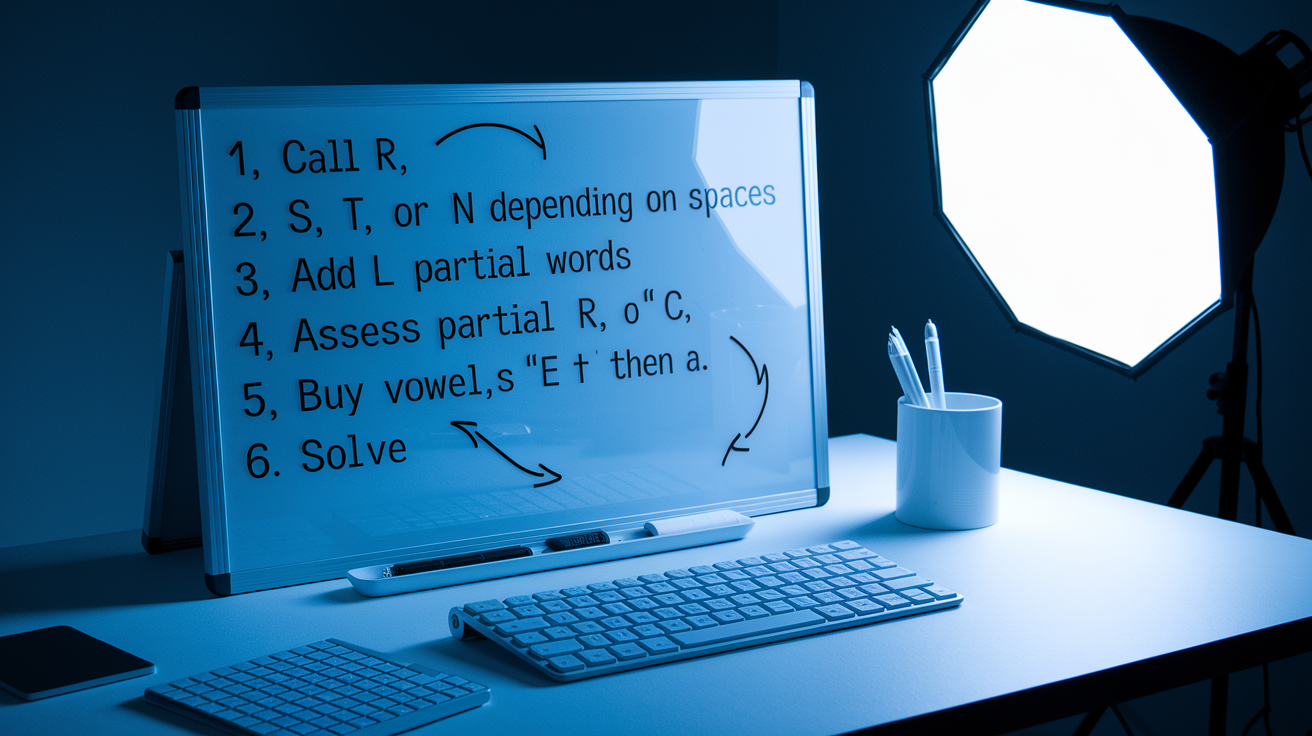
Follow this method every time you start a new puzzle:
- Call R as your first letter unless the category strongly suggests otherwise. R appears in more English words than any other consonant and often reveals critical positions.
- Follow with S, T, or N depending on visible spaces and category. S works well for plurals and possessives, T for common short words, N for verb forms and frequent nouns.
- Add L or C to round out your early consonant coverage. These letters fill in gaps R and T might have missed and are especially common in “Phrase” and “Before & After” categories.
- Assess the board for partial words. If you see spaces that could form “THE,” “ING,” or “AND,” buy a vowel only if it confirms two or more words at once.
- Prioritize E first, then A, when buying vowels. E is the most common vowel in English and appears in nearly every puzzle. A comes second and often completes short articles and conjunctions.
- Attempt to solve as soon as you can confidently identify the phrase. Waiting for a perfect board gives opponents a chance to steal the solve and the money.
Category-Specific Puzzle Patterns and What They Reveal

Certain categories come with built in expectations that drastically narrow your solving options. “Before & After” puzzles always connect two phrases through a shared middle word, so if you see spaces arranged in three distinct word groups, the middle group is your anchor. Look for common bridge words like “PARTY,” “STAR,” “TIME,” or “HOUSE” that fit naturally into multiple contexts. Once you identify the middle word, the outer phrases often snap into place because they’re usually well known sayings or titles. “Phrase” categories rely heavily on idioms, expressions, and common sayings, which means articles, prepositions, and conjunctions appear far more often than in other formats. Words like “THE,” “AND,” “IN,” “ON,” and “TO” should be your first targets after calling high frequency consonants.
“Thing” and “Things” puzzles describe objects, so expect concrete nouns with predictable suffixes. ING endings appear frequently in action related items like “RUNNING SHOES” or “SWIMMING POOL.” ER endings show up in tools and devices like “BLENDER” or “COMPUTER.” Plural forms mean you’ll almost always see an S at the end of at least one word, and compound nouns often feature repeated letters in predictable positions. “Food & Drink” puzzles lean heavily on common meal items, ingredients, and beverages. Suffixes like ING, ED, and S dominate, and double letters in words like “COFFEE,” “BUTTER,” and “APPLE” reveal multiple spaces at once.
Category based deduction lets you eliminate impossible words and focus on high probability fits. If the category is “Place” and you see a short word followed by a longer one, you’re likely looking at a city state combination or a famous landmark. If the category is “Person” and you spot a three word structure, expect a first name, middle initial, and last name, or a title followed by a full name. The more you train your brain to match category clues with common structural patterns, the faster you’ll solve puzzles before opponents even get a second turn.
| Category | Common Patterns | High-Probability Letters |
|---|---|---|
| Before & After | Shared middle word, bridge phrases, compound meanings | R, S, T, N, E, A |
| Phrase | Articles (THE, A, AN), conjunctions (AND, OR), prepositions (IN, ON, TO) | T, H, E, A, N, D |
| Thing / Things | ING, ER, ED endings, plurals with S, compound nouns, double letters | S, R, T, N, E, I |
| Food & Drink | ING, ED, S plurals, double letters (LL, FF, EE), common meal items | E, A, R, S, T, N |
Digital Gameplay Tactics for Wheel of Fortune Video Game Versions

Video game versions of Wheel of Fortune pull from highly consistent puzzle databases, meaning patterns repeat more predictably than on the live TV show. Once you’ve played through a few dozen puzzles, you’ll start recognizing phrases, categories, and even full solutions that cycle back into rotation. This repetition makes puzzle memorization a legitimate strategy, especially in older console releases where the total puzzle pool is smaller. If you’re playing on PlayStation, Xbox, or Nintendo Switch, keep a mental or physical note of puzzles you’ve seen before. The same solutions often reappear within the same play session or across multiple campaigns.
AI opponents in digital versions follow scripted difficulty tiers that determine how aggressively they guess letters and how quickly they attempt solves. Lower difficulty AI opponents often call suboptimal consonants and wait too long to buy vowels, giving you extra turns to lock in high value letters and solve the puzzle first. Higher difficulty AI opponents mimic optimal human play by prioritizing R, S, T, L, N, and E early, but they rarely deviate from rigid patterns. You can bait them into wasting turns by deliberately leaving low value consonants on the board and solving as soon as you have enough context.
- Memorize puzzles as you encounter them. Repeated solutions give you instant solves on future playthroughs.
- Exploit AI hesitation on vowel purchases. If the AI waits too long to buy E or A, jump in and solve before they recover.
- Spin conservatively when ahead. If you’re already leading in cash, prioritize safe consonants over high risk spins that could land on Bankrupt.
- Track which puzzles appear in which categories. Some digital versions assign the same puzzle to multiple categories across different rounds.
- Use the pause function to study partially revealed boards. This won’t work in timed modes, but in standard play, pausing lets you analyze patterns without pressure.
Bonus Round Strategy and Common Final Puzzle Patterns

The bonus round pre reveals R, S, T, L, N, and E because these six letters historically appear in the majority of English words, and the format assumes you’ve already earned the right to skip the obvious choices. Your job is to pick three additional consonants and one vowel that maximize new information, and the statistically strongest selections are C, D, M, and A. C appears frequently in common words and word endings, D shows up in past tense verbs and everyday nouns, M is common in longer words and compound structures, and A is the second most common vowel after E. This combination consistently reveals more letters than alternatives like G, H, P, or O.
Bonus puzzles lean heavily on predictable endings because producers know solvers have limited time and fewer tools. ING endings appear constantly, especially in “Thing” and “Phrase” categories, because they fit action oriented and descriptive words. ER endings show up in occupations, tools, and comparative adjectives, while ED endings dominate past tense verbs and adjectives. If you spot spaces that suggest a three letter ending and one of those letters is already revealed, your odds of completing the puzzle jump dramatically. Short words like “THE,” “AND,” “FOR,” and “BUT” also appear frequently because they pad the board and make the puzzle look harder than it actually is.
Watch for plurals and possessives. If the puzzle has multiple words and one of them already shows an S at the end from the pre reveal, you’re likely looking at a plural noun or possessive structure, which narrows the possible solutions. If you see an apostrophe, you’re dealing with a contraction or possessive, meaning the next letter is almost always T, S, or RE. Use the category as a secondary filter. “Person” puzzles often feature full names with first and last structures, “Place” puzzles skew toward cities or landmarks with recognizable patterns, and “Phrase” puzzles favor idioms and expressions with common word pairings. The more you train your brain to combine visible letters, category context, and ending patterns, the faster you’ll crack bonus rounds even when only a handful of letters are showing.
Final Words
You learned which letters reveal the most and how to pick consonants first, when to buy vowels, and how category clues point to likely word structures.
We also covered pattern recognition, a clear step-by-step letter order, digital-game tactics, and bonus-round picks that speed solves.
Keep this wheel of fortune game puzzle solving techniques walkthrough handy during play. Practice the steps, watch category cues, and adapt to AI patterns. You’ll start solving puzzles faster and enjoy more wins.
FAQ
Q: What letters statistically give the highest puzzle‑reveal rate?
A: The letters that give the highest reveal rate are R, S, T, L, N, and C. Start with these consonants to expose word shapes and common syllables quickly.
Q: What is a simple step‑by‑step method for efficient letter selection?
A: The step‑by‑step method is consonant first, pick two to three top consonants, buy vowels after two consonants, then fill remaining consonants and vowels to confirm the puzzle.
Q: When should I buy vowels and which ones first?
A: You should buy vowels after revealing at least two consonants; choose E and A first to confirm endings, then O or I to clarify word structure or plurals.
Q: How do puzzle categories change which letters or patterns to expect?
A: Puzzle categories change expected patterns: Phrase has short function words, Before & After shows overlapping words, Food & Drink often uses -ING or plurals—use those cues to target letters.
Q: What universal tactics work across all digital Wheel of Fortune versions?
A: Universal tactics are: start with R S T L N C, read the category fast, pick consonants first, buy vowels to confirm, watch repeats, avoid rare letters early, and trust common endings.
Q: How do digital and video‑game versions differ from the TV show?
A: Digital versions use consistent puzzle pools and repeat patterns; memorize common puzzles, note AI behavior, and exploit predictable letter distributions for faster solves.
Q: What should I choose in the bonus round after RSTLNE are revealed?
A: In the bonus round after R S T L N E, pick high‑probability consonants like C, D, M, G and a vowel like A or O to reveal likely endings and core stems.
Q: What bonus‑round endings appear most often and how do they help?
A: The most common bonus endings are ING, ER, and ED. Spotting those endings narrows letter choices and helps you pick additional letters that confirm the final answer.